AI for Marketing in 2026: Complete Guide to AI Consumer Insights

Samee
The marketing landscape has fundamentally shifted. AI for marketing isn't just a buzzword anymore - it's the competitive advantage that separates thriving brands from those struggling to understand their customers. In 2026, artificial intelligence has democratized consumer insights, allowing even small teams to access the kind of deep customer understanding that once required massive research budgets. This comprehensive guide explores how AI-powered consumer insights are reshaping marketing strategies, which tools actually deliver results, and how you can implement AI to transform your customer research from reactive to predictive.
The marketing landscape has fundamentally shifted. AI for marketing isn't just a buzzword anymore - it's the competitive advantage that separates thriving brands from those struggling to understand their customers. In 2026, artificial intelligence has democratized consumer insights, allowing even small teams to access the kind of deep customer understanding that once required massive research budgets.
This comprehensive guide explores how AI-powered consumer insights are reshaping marketing strategies, which tools actually deliver results, and how you can implement AI to transform your customer research from reactive to predictive
What Is AI for Marketing?
AI for marketing refers to the application of machine learning, natural language processing, and predictive analytics to automate, optimize, and enhance marketing activities. Rather than replacing human marketers, AI amplifies their capabilities - processing vast amounts of customer data, identifying patterns invisible to the human eye, and generating actionable insights at unprecedented speed.
The most transformative application of AI in marketing lies in consumer insights. Traditional market research required weeks of survey design, data collection, and manual analysis. AI consumer insights tools can now generate survey questions, analyze open-ended responses, identify sentiment patterns, and deliver recommendations in hours rather than weeks.
According to Gartner's 2024 Marketing Technology Survey, 73% of marketing leaders have already implemented some form of AI in their operations, with consumer insights and analytics being the top use case. The data is clear: AI isn't the future of marketing - it's the present.
The Evolution of Consumer Insights: From Manual to AI-Powered
Understanding how we arrived at AI-powered consumer insights helps contextualize why this technology matters so much for modern marketing teams.
Traditional Market Research (Pre-2010)
Market research companies dominated the landscape. Conducting consumer research meant hiring agencies, waiting months for results, and paying five-figure fees for insights that were often outdated by the time they arrived. Focus groups, telephone surveys, and mail questionnaires were standard practice. The process was rigorous but painfully slow.
Digital Research Tools (2010-2020)
The rise of SaaS survey platforms like SurveyMonkey and Qualtrics democratized data collection. Suddenly, businesses could create and distribute surveys themselves. However, analysis remained largely manual. Marketers spent countless hours in spreadsheets, trying to extract meaning from hundreds or thousands of responses.
AI-Powered Insights (2020-Present)
Today's AI tools for customer sentiment analysis don't just collect data - they understand it. Natural language processing can analyze open-ended survey responses, social media comments, and customer support tickets simultaneously, identifying themes, sentiment, and emerging patterns without human intervention. Predictive analytics anticipate customer behavior before it happens.
Platforms like MindProbe.ai represent this new generation of consumer insights platforms, where AI handles everything from survey generation to insight extraction, allowing marketing teams to focus on strategy rather than data wrangling.
How AI Transforms Customer Research for Shopify Brands and DTC Companies
Direct-to-consumer brands face unique challenges. Without the buffer of retailers, DTC companies must understand their customers intimately to succeed. AI-powered customer research for Shopify brands has become essential for several reasons:
Speed to Market
Shopify brands operate in fast-moving markets where trends emerge and fade within weeks. Traditional research timelines don't work. AI consumer insights platforms can launch surveys, collect responses, and generate analysis in days, allowing brands to validate product ideas, test messaging, or understand customer pain points before competitors even begin their research.
Cost Efficiency
Most DTC brands lack the budgets for traditional market research companies. AI tools provide enterprise-level insights at a fraction of the cost. A comprehensive customer sentiment analysis that might cost $50,000 through a traditional agency can now be conducted for under $1,000 using AI-powered platforms.
Continuous Learning
Rather than conducting quarterly or annual research studies, AI enables continuous consumer insights. Every customer interaction - from survey responses to product reviews to support tickets - feeds into your understanding of customer needs, preferences, and behaviors. This continuous feedback loop helps Shopify brands adapt in real-time.
Personalization at Scale
AI analyzes individual customer data while identifying broader segments and patterns. This dual capability allows DTC brands to personalize messaging and offers while understanding market-level trends. You can know what Sarah in Portland wants while also understanding what millennials in the Pacific Northwest collectively value.
Essential AI Tools for Customer Sentiment Analysis
Not all AI marketing tools deliver equal value. Here's what actually matters when evaluating AI consumer insights platforms:
Natural Language Processing (NLP) Capabilities
The backbone of meaningful AI consumer insights is sophisticated NLP. This technology enables machines to understand human language - including context, sentiment, and nuance. When customers write "This product is sick!" NLP understands whether they mean "sick" as positive slang or actually problematic.
Quality NLP identifies:
- Sentiment polarity: Positive, negative, or neutral feelings
- Emotion detection: Specific emotions like joy, frustration, disappointment, or excitement
- Theme extraction: Recurring topics across hundreds or thousands of responses
- Intent recognition: What customers actually want or need
Automated Survey Generation
The best AI tools for customer sentiment analysis don't just analyze responses - they help create better surveys. AI can generate contextually relevant questions based on your research objectives, industry, and target audience. This eliminates the blank-page problem that paralyzes many marketing teams.
For example, if you're a skincare brand researching customer preferences, AI might automatically suggest questions about skin type, concerns, routine complexity, ingredient preferences, and price sensitivity - questions informed by analyzing thousands of similar successful surveys.
Real-Time Analytics Dashboards
AI consumer insights platforms should provide instant visibility into your research data. As responses arrive, dashboards update with sentiment scores, key themes, demographic breakdowns, and emerging patterns. This real-time capability allows you to spot issues or opportunities immediately rather than waiting for a final report.
Predictive Analytics
The most advanced AI marketing tools don't just tell you what customers think now - they predict what they'll do next. By analyzing patterns in historical data, AI can forecast which customers are likely to churn, which product features will drive adoption, or which messaging will resonate with specific segments.
Integration Capabilities
AI consumer insights are most valuable when connected to your broader marketing ecosystem. Look for platforms that integrate with your CRM (Salesforce, HubSpot), ecommerce platform (Shopify, BigCommerce), communication tools (Slack, Teams), and data warehouses. These connections enable insights to flow directly into your workflows.
MindProbe.ai exemplifies this integrated approach, connecting survey insights directly to the tools marketing teams already use daily, eliminating the data silos that plague many organizations.
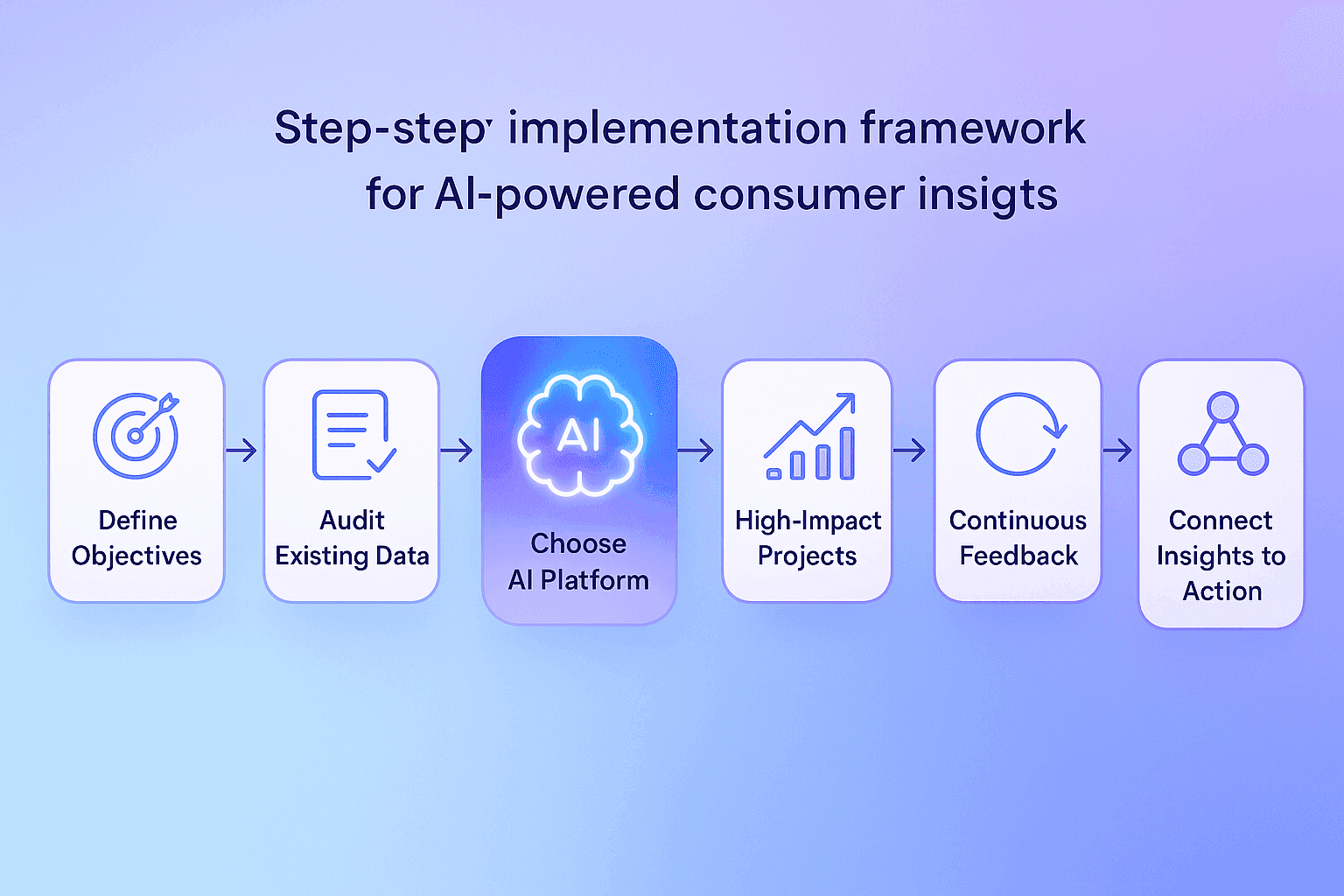
Implementing AI-Powered Consumer Insights: A Step-by-Step Framework
Knowing AI for marketing matters is different from successfully implementing it. Here's a practical framework for introducing AI-powered consumer insights into your marketing operations:
Step 1: Define Your Research Objectives
AI can answer almost any question about your customers, but you need to know what to ask. Start with specific business objectives:
- Are you trying to reduce churn?
- Do you need to validate a new product concept?
- Are you optimizing your onboarding experience?
- Do you want to understand why customers choose competitors?
Clear objectives guide your AI implementation and ensure insights translate to action.
Step 2: Audit Your Existing Data
Most companies sit on goldmines of customer data they've never properly analyzed. Before collecting new information, apply AI tools to existing sources:
- Customer support tickets
- Product reviews
- Social media mentions
- Previous survey responses
- Sales call transcripts
- Email interactions
AI tools for customer sentiment analysis can retroactively analyze this data, often revealing insights that were always there but invisible without AI.
Step 3: Choose the Right AI Consumer Insights Platform
Not every business needs the same solution. Consider:
- Team size: Some platforms are built for enterprise teams; others excel for small, agile teams
- Technical capabilities: Do you need developer-friendly APIs or no-code simplicity?
- Budget: AI tools range from free basic plans to enterprise solutions
- Use cases: Some platforms specialize in brand tracking, others in product research or customer experience
For DTC brands and growing companies, platforms like here at MindProbe.ai offer the ideal balance of sophistication and usability - powerful AI without requiring a dedicated data science and research team.
Step 4: Start with High-Impact, Low-Complexity Projects
Don't try to transform your entire research operation overnight. Begin with a single, high-value use case:
- Survey your most recent customers about their buying experience
- Analyze sentiment in your last 1,000 support tickets
- Test two different value propositions with a small audience
- Understand why trial users don't convert to paid customers
These focused projects demonstrate AI's value quickly, building organizational buy-in for broader implementation.
Step 5: Establish Continuous Feedback Loops
The real power of AI consumer insights emerges when research becomes continuous rather than episodic. Build systems that automatically:
- Survey customers at key journey milestones
- Monitor sentiment across review sites and social media
- Track brand perception metrics monthly
- Gather product feedback after each release
This continuous approach transforms consumer insights from periodic snapshots to always-on intelligence.
Step 6: Connect Insights to Action
Insights only matter if they change what you do. Create clear pathways from research findings to business decisions:
- Share key insights in weekly marketing meetings
- Build dashboards that executives actually check
- Create alert systems for significant sentiment shifts
- Assign owners to act on major themes discovered in research
The best AI for marketing implementations embed insights directly into decision-making processes rather than treating research as a separate, occasional activity.
Real-World Applications: How Leading Brands Use AI for Marketing
Theory matters less than results. Here's how innovative companies apply AI consumer insights:
Product Development at DTC Brands
A sustainable fashion Shopify brand used AI-powered customer research to identify that customers valued durability over trendiness - contradicting the founder's assumptions. By surveying customers through an AI consumer insights platform, they discovered specific pain points: clothing that looked great initially but fell apart after a few washes.
The brand reformulated their entire product line around longevity, adjusting messaging to emphasize "investment pieces" rather than "affordable fashion." Revenue increased 47% year-over-year, with customer lifetime value doubling.
Campaign Optimization for B2C Companies
A meal kit delivery service used AI tools for customer sentiment analysis to analyze feedback from 50,000 customers across surveys, reviews, and support tickets. The AI identified that customers weren't complaining about food quality or recipes - they were frustrated by packaging waste.
This insight led to a sustainability-focused campaign that resonated deeply with their environmentally conscious audience. The campaign generated 3x typical engagement rates and reduced churn by 22% among customers who saw the messaging.
Customer Experience Improvement
An online fitness platform used AI consumer insights to analyze why users canceled subscriptions. Traditional analysis showed generic reasons like "too expensive" or "not using it enough." AI sentiment analysis revealed the deeper truth: users felt overwhelmed by too many workout options and didn't know where to start.
The company implemented AI-powered personalized workout recommendations and onboarding sequences. Cancellations decreased 34% within three months.
Competitive Intelligence
A beauty brand used AI-powered customer research to understand not just why customers bought from them, but why others chose competitors. By surveying both customers and non-customers, their AI consumer insights platform identified specific competitor advantages: faster shipping and better unboxing experiences.
Rather than competing on product (where they were already strong), they invested in logistics and packaging. Market share increased 12% in six months.
The ROI of AI Consumer Insights
Investing in AI for marketing requires justification. Here's how to calculate and communicate ROI:
Time Savings
Traditional market research projects consume 40-80 hours of marketing team time. AI platforms reduce this to 5-10 hours. At an average loaded cost of $75/hour for marketing professionals, a single project saves $2,625-$5,250 in labor costs alone.
Most marketing teams conduct research quarterly at minimum. Annual time savings: $10,500-$21,000, plus freeing team capacity for strategic work.
Cost Avoidance
Market research companies typically charge $25,000-$75,000 for comprehensive consumer insights projects. AI consumer insights platforms cost $200-$2,000 monthly. Even at the higher end, you're saving $22,000+ per project.
Revenue Impact
The most significant ROI comes from better decisions. AI-powered customer research for Shopify brands has helped companies:
• Increase conversion rates by 15-40% through better messaging
• Reduce churn by 20-35% by addressing hidden pain points
• Improve customer acquisition cost by 25-45% through better targeting
• Boost customer lifetime value by 30-60% via enhanced experiences
Even conservative improvements generate substantial returns. A DTC brand with $5M annual revenue that increases conversion by just 10% adds $500,000 in revenue - typically worth $100,000-$150,000 in profit.
Risk Reduction
Perhaps most valuable is what AI consumer insights prevent: expensive mistakes. Launching products customers don't want, investing in campaigns that miss the mark, or making strategic pivots based on assumptions rather than data.
A single avoided product failure (typical cost: $100,000-$500,000 for DTC brands) pays for years of AI consumer insights platforms.
Common Challenges and How to Overcome Them
Implementing AI for marketing isn't without obstacles. Here's how to address common challenges:
"Our team isn't technical enough"
Modern AI consumer insights platforms are designed for marketers, not data scientists. Look for solutions with intuitive interfaces, pre-built templates, and automated analysis. Platforms like MindProbe.ai require zero coding or technical expertise.
"We don't have enough data"
AI tools for customer sentiment analysis work with surprisingly small datasets. You can generate valuable insights from 100-200 survey responses. Start small and scale as you build confidence.
"Our customers won't respond to surveys"
AI enables shorter, more engaging surveys that boost response rates. Interactive formats, conversational language, and mobile-optimized designs typically achieve 25-40% response rates - far higher than traditional surveys.
Additionally, AI can analyze existing data sources (reviews, support tickets, social media) that don't require active customer participation.
"AI insights feel impersonal"
This misconception reverses reality. AI consumer insights reveal the nuanced, individual perspectives within your customer base that aggregate statistics obscure. You discover not just that "customers want better quality" but specifically what quality means to different segments.
"We already use Google Analytics"
Behavioral data (what customers do) and attitudinal data (what customers think and feel) serve different purposes. AI-powered customer research fills the "why" gap that analytics alone can't answer. The most effective marketing strategies combine both.
The Future of AI for Marketing: What's Coming Next
AI consumer insights are evolving rapidly. Here's what's emerging:
Multimodal Analysis
Next-generation AI will simultaneously analyze text, images, video, and voice to understand customer sentiment. Imagine surveying customers about packaging and having AI analyze their video responses to detect emotional reactions.
Hyper-Personalization
AI will enable one-to-one consumer insights at scale. Rather than segmenting customers into groups, marketers will understand individual preferences and behaviors while still identifying broader patterns.
Predictive Product Development
AI will analyze market signals - from search trends to social conversations to early feedback - to predict which products will succeed before they launch. Product development will shift from reactive to predictive.
Autonomous Research Operations
AI agents will automatically conduct research based on defined parameters, continuously monitoring customer sentiment, competitive dynamics, and market trends without human intervention. Marketers will shift from conducting research to interpreting and acting on findings.
Ethical AI and Privacy
As AI capabilities expand, so do privacy concerns. The future of AI for marketing will balance powerful insights with rigorous data protection, transparency, and customer control over their information. Leaders will differentiate through trustworthy AI practices.
According to Forrester's 2025 Marketing Predictions, companies that master AI-powered consumer insights will achieve 2-3x faster growth rates than competitors still relying on traditional research methods.
Getting Started with AI Consumer Insights Today
You don't need massive budgets or technical teams to benefit from AI for marketing. Here's your action plan:
This Week:
- Audit existing customer data you can analyze with AI tools
- Identify your most pressing customer understanding gaps
- Research AI consumer insights platforms (start with MindProbe.ai for DTC-friendly options)
This Month:
- Select an AI platform and run your first pilot project
- Survey a small customer segment about a specific topic
- Compare AI-generated insights to your existing assumptions
This Quarter:
- Establish regular research cadences using AI tools
- Connect insights to decision-making processes
- Train your team on interpreting and acting on AI consumer insights
- Measure ROI from your initial implementation
This Year:
- Build comprehensive continuous feedback systems
- Expand AI applications across marketing operations
- Develop competitive advantage through superior customer understanding
Conclusion: AI for Marketing Is Your Competitive Edge
The marketing teams winning in 2026 share one characteristic: they understand their customers better than competitors do. AI consumer insights have democratized this understanding, making world-class consumer research accessible to businesses of all sizes.
AI-powered customer research for Shopify brands, DTC companies, and B2C businesses isn't about replacing human creativity or strategic thinking - it's about amplifying both. AI handles the time-consuming work of data collection and analysis, freeing marketers to focus on interpretation, strategy, and creativity.
The question isn't whether to adopt AI for marketing, but how quickly you can implement it. Your competitors are already using AI consumer insights to understand customers better, move faster, and make smarter decisions. The gap between AI-powered marketing teams and those relying on intuition and manual research widens every month.
The good news? Getting started is easier than ever. Modern AI tools for customer sentiment analysis require no technical expertise, minimal budgets, and can demonstrate value within weeks. Platforms like MindProbe.ai are purpose-built to help marketing teams harness AI power without the complexity.
Your customers are sharing insights every day - in surveys, reviews, support tickets, and social media. AI simply helps you hear what they're actually saying. The future of marketing belongs to companies that listen better. Start listening today.
Ready to transform your customer research with AI?
Explore MindProbe.ai and discover how AI-powered consumer insights can revolutionize your marketing strategy in days, not months.