Voice of the Customer Programs: Building Better B2C Relationships Through Surveys

Samee
Discover how Voice of the Customer programs can transform B2C relationships. Learn how to build better surveys, leverage MindProbe’s AI-powered insights, and turn feedback into long-term loyalty.
1. Introduction
In today’s B2C market, consumers are more vocal than ever. They share their thoughts on social media, write detailed product reviews, and compare brands at lightning speed. Amid this noise, Voice of the Customer (VoC) programs have emerged as a strategic imperative for brands looking to build deeper, more meaningful relationships with their audience. By systematically gathering and analyzing feedback from customers, VoC programs provide insights into what consumers truly want allowing companies to refine products, personalize experiences, and boost loyalty.
One of the most potent tools within any VoC program is the survey. Surveys allow you to pose direct questions to your customers, revealing their preferences, pain points, and emotional responses to your brand or product line. Yet, not all surveys are created equal. The design, distribution, and analysis phases can make or break the insights you glean, which is why technology plays a vital role. Platforms like MindProbe, an AI-powered market research tool, streamline everything from sentiment analysis to auto-tagging of responses, enabling you to turn raw data into actionable intelligence.
In this comprehensive guide, we’ll dive into the importance of VoC in B2C settings, explore the core components of a successful VoC program, and show you how to leverage surveys to build stronger customer relationships. By the end, you’ll have a clear roadmap for implementing or refining your VoC efforts empowered by data-driven insights that foster long-term growth and customer retention.
2. Why Voice of the Customer (VoC) Matters in B2C Markets
Voice of the Customer refers to a systematic approach where brands actively capture, analyze, and act upon customer feedback. But why does this matter so much in B2C markets?
1. Increasing Competition
- With the rise of digital commerce, consumers can compare prices, read reviews, and switch to competitors in a matter of clicks. A strong VoC program helps you stay ahead by proactively understanding and meeting customer needs.
2. Customer-Centricity as a Differentiator
- Many B2C companies can replicate product features or marketing campaigns, but genuine customer centricity is harder to copy. By regularly listening and responding to the voice of your customers, you develop a reputation for responsiveness and care.
3. Higher Retention and Loyalty
- Research shows that companies with robust VoC program often achieve double-digit increases in customer retention. Satisfied customers are more likely to repurchase, recommend, and advocate for your brand.
4. Product and Service Innovation
- Your customers often have unfiltered, on-the-ground perspectives that can spark game-changing innovations. By tracking recurring suggestions or complaints, you can identify white spaces in your offerings.
Ultimately, a well-run VoC program gives you a competitive edge, turning data into a deep understanding of what drives customer happiness and loyalty and leveraging that knowledge to shape strategic decisions.
3. Core Components of a VoC Program
A successful Voice of the Customer program encompasses more than just sending out an occasional survey. It’s a holistic framework designed to capture feedback across multiple touchpoints, analyze it meaningfully, and take action based on insights.
1. Data Collection
- Gather customer input from various channels surveys, social media mentions, customer service calls, online reviews. Each channel offers distinct perspectives that can enrich your overall VoC data set.
- Once you’ve collected the data, the next step is to structure it. This might include sentiment analysis, theme clustering, or frequency distributions. Tools like MindProbe help automate these processes, reducing human error and accelerating time-to-insight.
3. Action Planning
- Insights without action lose their value quickly. A dedicated team or, at minimum, a designated champion should be responsible for translating insights into product improvements, marketing campaigns, or operational tweaks.
4. Continuous Improvement
- VoC is not a “set it and forget it” endeavor. Markets evolve, and so do customer expectations. Scheduling regular check-ins to update your VoC strategy ensures you remain responsive to emerging trends.
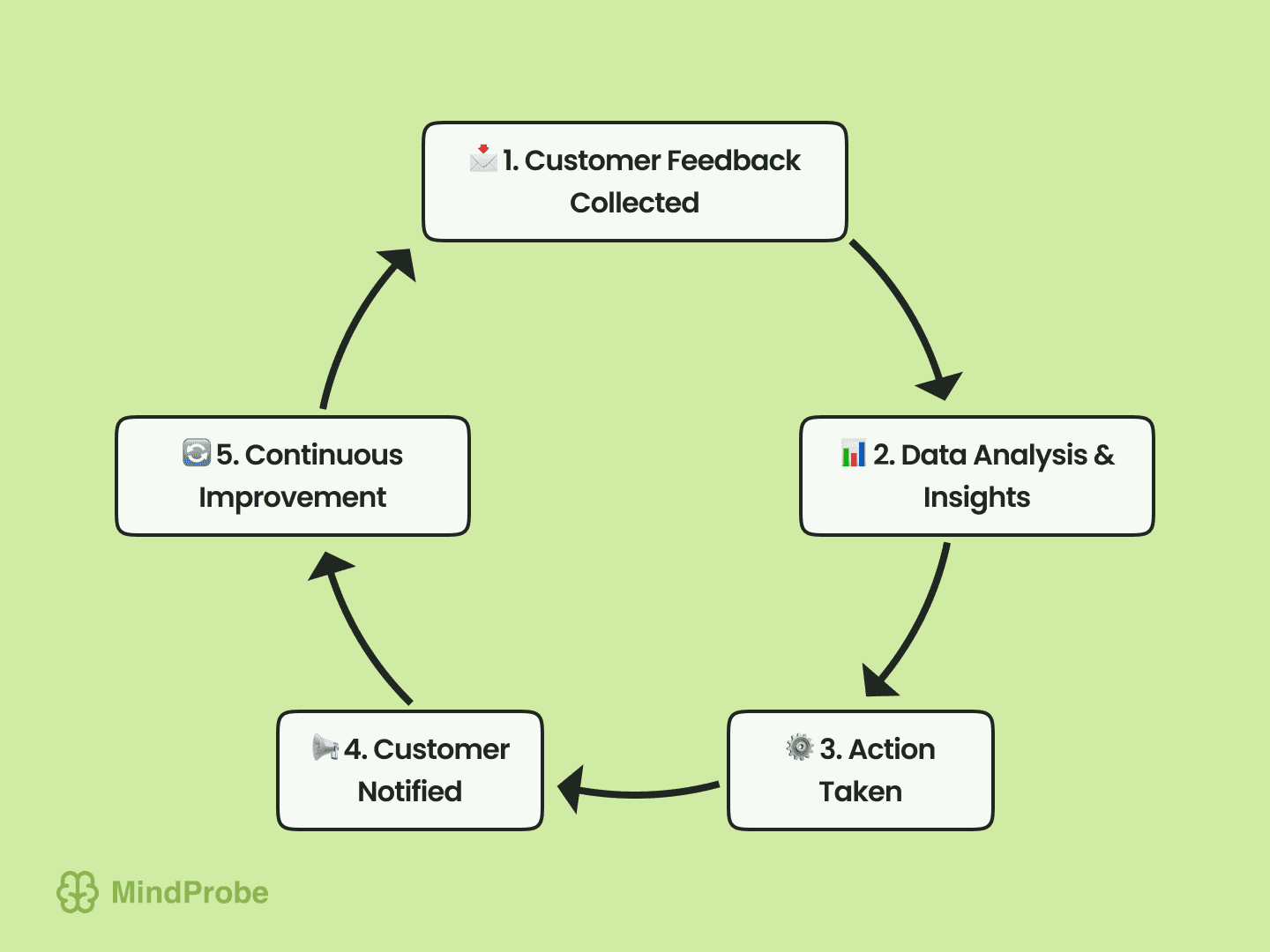
When integrated properly, these components form a feedback loop that continually refines every aspect of your brand from product features and pricing to marketing messages and customer service protocols.
4. The Role of Surveys in VoC
Among the various channels for collecting customer feedback (such as social media sentiment or customer support logs), surveys stand out for their targeted, direct, and customizable nature. They allow you to ask the exact questions you need answered, gleaning specific insights that might not be immediately apparent in unstructured data.
Why Surveys Are Key
1. Specificity: You can zero in on particular topics, such as satisfaction with a new feature or thoughts on pricing.
2. Scalability: Distribute the same survey to thousands of respondents without incurring massive operational costs.
3. Standardization: Standard questions yield quantifiable data, making analysis (and comparisons over time) simpler.
4. Actionable Results: Surveys can be designed to lead directly into your action planning, e.g., “If more than 60% say the check-out process is confusing, we’ll redesign it.”
In a VoC program, surveys become the backbone of your data collection efforts especially if you use advanced tools to automate analysis and swiftly convert responses into actionable steps.
5. Designing a Survey for a VoC Program
Creating a survey that genuinely reflects the voice of your customers requires strategic planning and attention to detail. Below are key considerations for ensuring your survey sets the stage for valuable insights.
5.1 Setting Objectives
Before crafting questions:
- Clarify Your Goals: Are you measuring customer satisfaction post-purchase? Gathering ideas for product improvements? Investigating reasons for churn? Pinpoint your main objective to keep your questions focused.
- Identify Your Audience: The questions you ask will differ based on whether you’re surveying new customers, long-time loyalists, or prospective leads. Tailor the language and question types to each group’s context.
5.2 Choosing Question Types
A robust VoC survey usually blends quantitative and qualitative items:
- Multiple-Choice / Rating Scales
- Offer quick, measurable insights into satisfaction or agreement levels. For instance, “On a scale of 1–5, how would you rate your recent experience with our customer service?”
- Open-Ended Questions
- Enable customers to share unprompted feedback. This is invaluable for discovering new areas of concern or opportunity that you hadn’t considered. Platforms like MindProbe can auto-tag and analyze these responses for common themes or sentiment.
- Likert Scales
- Common in measuring agreement or intensity (e.g., “Strongly Disagree” to “Strongly Agree”), Likert scales can reveal subtle attitudinal shifts when tracked over time.
5.3 Timing and Frequency
- Post-Purchase: Sending a survey shortly after a customer interacts with your product or service keeps the experience fresh in their mind.
- Periodic Check-Ins: For ongoing relationships like in subscription or membership contexts quarterly or semi-annual surveys can track changes in satisfaction or brand perception.
- Event-Driven: Triggered after milestones (e.g., 30 days after a new user signs up) or following specific events (like a support ticket closure).
Remember to strike a balance: too many surveys can lead to fatigue and reduced response rates, while too few leave you uninformed about evolving customer needs.
6. How MindProbe Elevates Your VoC Initiative
Building out a VoC program and associated surveys can be time-consuming and prone to errors if done manually. This is where MindProbe, an AI-powered market research platform, transforms the process.
6.1 AI-Powered Sentiment Analysis
Traditional manual analysis of open-ended survey responses can be labor intensive and subjective. MindProbe’s AI automatically categorizes feedback as positive, negative, or neutral, highlighting emotional undercurrents in real time. If multiple respondents mention “frustration” or “confusion” around the same process, you’ll spot this trend right away enabling you to prioritize the issue.
6.2 Auto-Tagging of Responses
Beyond sentiment, MindProbe can auto-tag recurring words or themes (e.g., “delivery time,” “quality,” “customer service”). This feature saves countless hours you’d otherwise spend combing through feedback, letting you quickly identify and group common pain points or praises.
6.3 Real-Time Dashboard and Segmentation
As your survey responses roll in, MindProbe’s dashboard updates in real time. You can filter data by demographics, purchase history, or engagement level to see how different segments perceive your brand. If you notice that one segment consistently flags a specific issue, you can act swiftly to address it.
Trial and Pricing: Unlike some platforms that offer a limited free tier, MindProbe provides a 7-day trial with full-feature access and then moves to paid plans no free subscriptions. This ensures you experience the complete suite of AI-driven tools before committing.
7. Overcoming Common VoC Pitfalls
Even well-intentioned VoC program can stumble if not executed carefully. Here are some pitfalls to watch out for and how to dodge them.
7.1 Biased or Leading Questions
- Problem: If your questions nudge respondents toward a certain answer (e.g., “Don’t you love our new interface?”), your data becomes skewed and less reliable.
- Solution: Craft neutral phrasing. A question like, “How would you rate your experience with our new interface?” is far more objective. Tools like MindProbe can also flag words or phrases that often imply bias.
7.2 Survey Fatigue and Low Response Rates
- Problem: Sending too many surveys or making them too long causes drop-off and disinterest. In B2C, time is precious, and you might only get one shot at a customer’s attention.
- Solution: Keep surveys concise and targeted. If you must gather extensive data, break it into multiple shorter surveys, or focus on a single theme at a time.
7.3 Data Overload and Inaction
- Problem: Large VoC program generate mountains of data. Without a structured plan, you risk drowning in feedback with no clear path forward.
- Solution: Use advanced analytics tools like MindProbe to auto-tag and segment responses. Assign clear accountability for acting on each major finding, whether it’s your product team or marketing department.
8. Real-World Examples of Successful VoC Programs
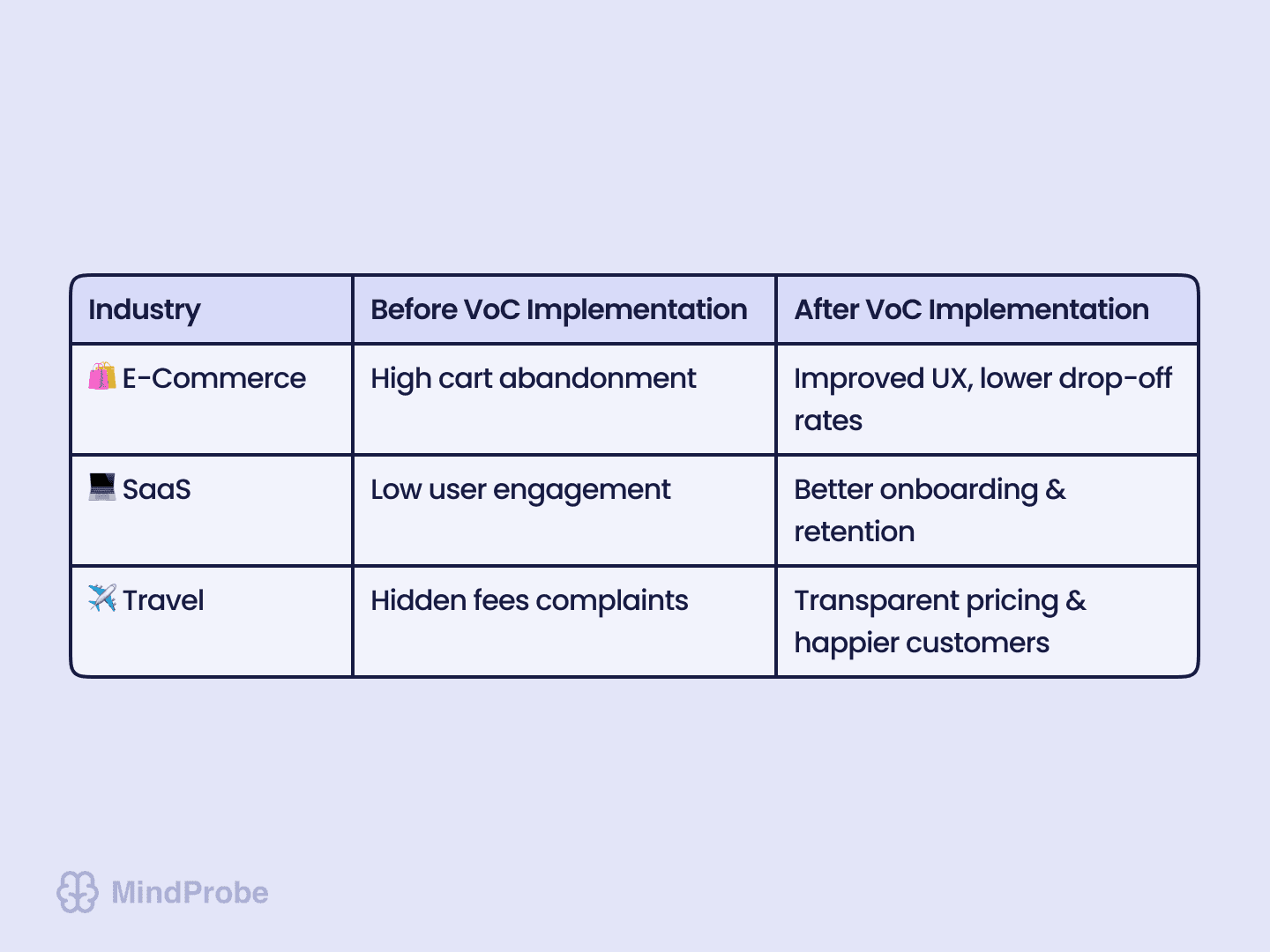
Let’s look at how different B2C industries deploy VoC and the kinds of results they achieve.
8.1 E-Commerce and Retail
Scenario: An online fashion retailer wants to reduce cart abandonment.
- VoC Approach:
1. Post-Abandonment Survey: Send a brief, two-question survey asking why customers left without buying.
2. MindProbe Analysis: AI tags frequent mentions of “high shipping costs,” “confusing checkout,” and “lack of size options.”
3. Action: The retailer implements free shipping over a certain threshold, refines the checkout flow, and expands size availability.
- Outcome: Abandonment rates drop by 20%, and repeated brand mentions on social media praise the improved checkout process.
8.2 SaaS and Subscription Services
Scenario: A SaaS platform that offers project management tools notices a dip in monthly active users.
- VoC Approach:
1. Cancellation Survey: Deployed whenever a user cancels or downgrades their subscription.
2. MindProbe Sentiment Analysis: Identifies recurring dissatisfaction with the new pricing tier and a mention of complex onboarding.
3. Action: Management restructures pricing, adding a mid-tier option, and invests in a guided onboarding feature.
- Outcome: Churn decreases by 15% over two quarters, and user engagement rebounds.
8.3 Hospitality and Travel
Scenario: A travel booking site wants to improve reviews and referral traffic.
- VoC Approach:
1. Post-Booking Survey: Asks travelers to rate overall satisfaction, ease of booking, and highlight any issues.
2. Real-Time Analytics: MindProbe’s dashboard shows negative sentiment spikes around hidden fees.
3. Action: The site clearly displays final prices upfront, removing unexpected charges at checkout.
- Outcome: Customer satisfaction scores rise, negative reviews about hidden fees plummet, and referral rates climb by 10%.
9. Measuring Success and ROI
A VoC program is an investment, and like any investment, you’ll want to measure whether it’s paying off. Common metrics include:
- Gauges overall brand advocacy, telling you if customers would recommend your brand to others.
2. Customer Satisfaction Score (CSAT)
- Measures short-term happiness with specific interactions like a purchase or support ticket.
3. Customer Effort Score (CES)
- Assesses how easy it is for a customer to accomplish a task (e.g., making a return or finding product information). Lower effort often correlates with higher loyalty.
4. Repeat Purchase Rate
- Particularly in B2C retail, an increase in repeat purchases or subscription renewals can indicate your VoC-inspired improvements are resonating.
5. Churn Rate
- In subscription or membership models, a falling churn rate is a strong indicator that customers see ongoing value in your offerings.
By regularly tracking these metrics, you can correlate changes to VoC-driven actions and demonstrate tangible ROI to stakeholders.
10. Creating a Continuous Feedback Loop
A one-and-done survey or a sporadic check-in is no longer sufficient in competitive B2C environments. You need to embed feedback loops throughout the customer journey:
- Trigger Surveys at Key Touchpoints: For instance, after a product purchase, a support call, or a website visit.
- Close the Loop Publicly: If your VoC program leads to a meaningful improvement, announce it to your customer base acknowledging their role in driving positive change.
- Refine Over Time: As your product or market evolves, so should your surveys. Continuously update question phrasing, add new focus areas, and retire questions that no longer yield valuable insights.
By making continuous improvement a core part of your organizational culture, you ensure VoC is more than a buzzword it’s a strategic advantage that’s woven into daily operations.
11. Conclusion
Voice of the Customer programs have become a linchpin for brands aiming to excel in B2C relationships. When executed well, they offer unparalleled insights into customer sentiment, preferences, and emerging demands—insights you simply can’t afford to ignore in a world brimming with alternatives. Surveys are the linchpin of these programs, enabling brands to ask targeted questions, collect structured data, and glean clear, actionable feedback.
However, the success of any VoC effort hinges on effective analysis and prompt action. This is where MindProbe comes into play: an AI-driven platform designed to auto-tag responses, interpret sentiment at scale, and present real-time analytics dashboards that help you spot trends quickly. With a 7-day trial (no free subscriptions), you can experience the full feature set from designing your survey and distributing it to a targeted B2C audience, to drilling down into granular insights that spark tangible improvements.
As you integrate VoC programs more deeply into your operations, remember that engagement is a two-way street. The more you act upon and publicly acknowledge customer feedback, the more customers will be willing to share their voice in the future. By fostering an environment of continuous listening, meaningful action, and transparent communication, you not only solve current pain points but also shape a sustainable pathway for long-term loyalty, brand advocacy, and market leadership.