7 Survey vs Questionnaire Examples Every Researcher Should Know

Samee
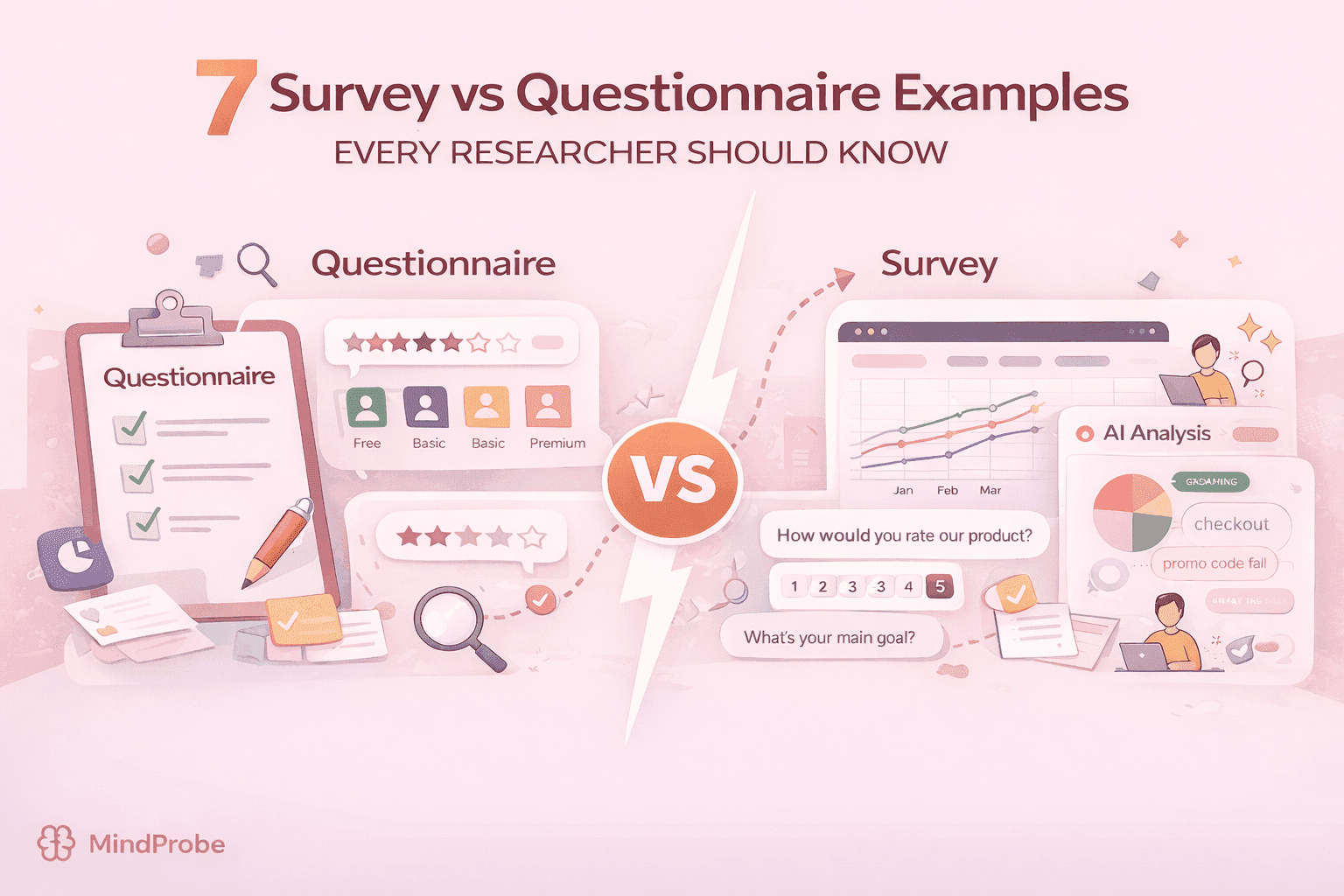
Surveys and questionnaires are often used interchangeably, but they are not the same. This guide breaks down 7 practical survey vs questionnaire examples every researcher should know, explaining when to use each, why the difference matters, and how modern teams turn feedback into decisions.
Surveys and questionnaires are frequently treated as interchangeable terms. In practice, that confusion leads to weak research, misleading insights, and poor decision-making.
Most teams believe they are “ running surveys ” when, in reality, they are only distributing questionnaires. They collect responses, count scores, and summarise comments, but still struggle to explain why customers behave the way they do or what to do next.
The difference matters.
A questionnaire is a tool for collecting information.
A survey is a structured research process designed to generate insight and inform decisions.
Understanding the difference is essential for researchers, product teams, marketers, and founders who rely on customer data to guide strategy.
In this article, we walk through 7 practical survey vs questionnaire examples, explaining when each is appropriate, what mistakes teams commonly make, and how modern research platforms like MindProbe help teams move from data collection to decision-ready insight.
Surveys vs questionnaires: the core distinction
Before diving into examples, it is important to establish a clear baseline.
A questionnaire:
- Is a set of questions
- Focuses on data collection
- Captures what respondents say
- Can be run quickly and repeatedly
A survey:
- Is the full research process
- Includes question design, sampling, segmentation, analysis, and interpretation
- Explains why feedback exists
- Is tied to a specific decision or hypothesis
Questionnaires are components of surveys, but they are not surveys on their own.
This distinction becomes clearer when we look at real research scenarios.
Example 1: Feature feedback collection
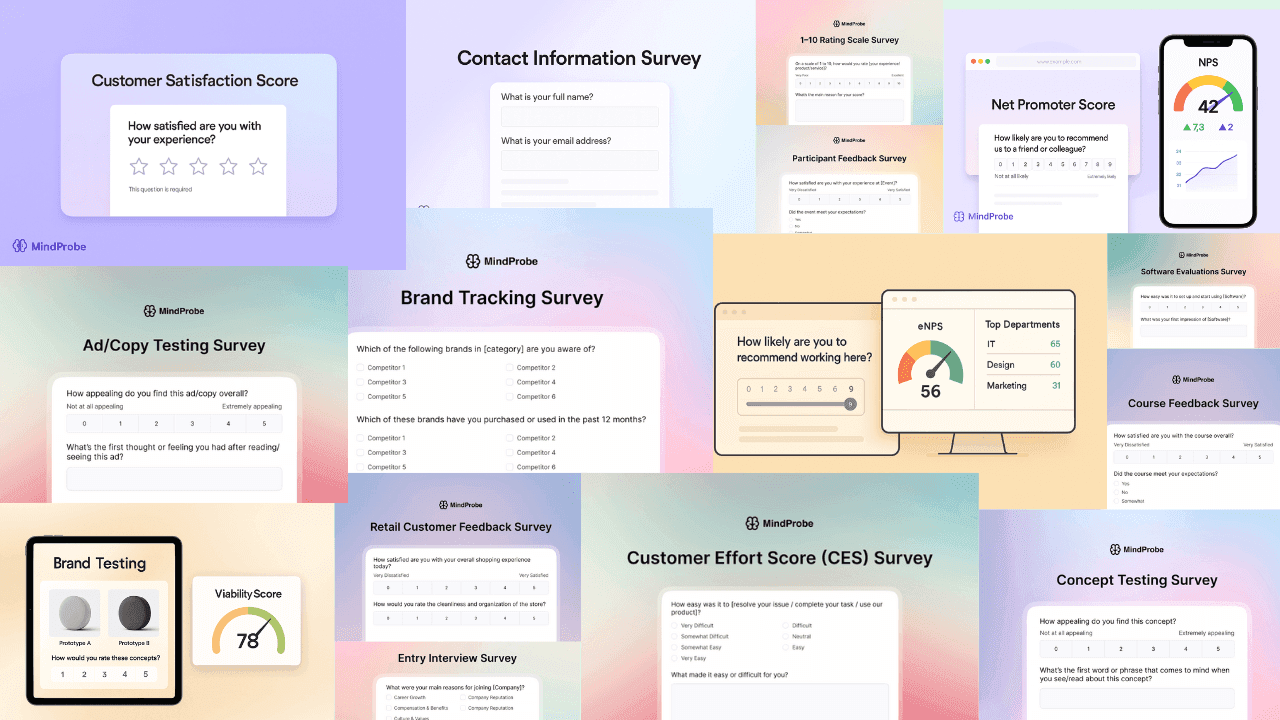
Questionnaire example
A product team sends a short form asking:
- How satisfied are you with Feature X?
- What would you improve?
- Would you recommend this feature to others?
This questionnaire collects useful input but leaves interpretation open-ended.
Survey example
A feature feedback survey:
- Segments responses by usage frequency and customer type
- Combines satisfaction scores with open-ended “why” questions
- Analyses patterns across segments
- Outputs clear recommendations for improvement or investment
Key takeaway:
Questionnaires capture opinions. Surveys translate feedback into prioritisation insight. MindProbe has a ready-made Feature Feedback template for you to use here.
Example 2: In-product experience feedback
Questionnaire example
A generic pop-up asks:
- How was your experience today?
Responses are detached from behaviour and timing.
Survey example
An in-product intercept survey:
- Triggers after a specific action or friction point
- Captures feedback in context
- Analyses responses alongside behavioural data
- Identifies experience breakdowns tied to real usage
Key takeaway:
Context turns feedback into insight. In-product surveys outperform standalone questionnaires. MindProbe makes it easy for you to run In-Product Surveys. Get setup in minutes not hours!
Example 3: Net Promoter Score (NPS)
Questionnaire example
A standard NPS form asks:
- How likely are you to recommend us?
- Why did you give this score?
Many teams stop here.
Survey example
An NPS survey:
- Segments promoters, passives, and detractors
- Analyses themes within each group
- Tracks drivers of advocacy and churn over time
- Feeds insight into roadmap and retention strategy
Key takeaway:
NPS without analysis is a metric. NPS as a survey becomes a decision tool. MindProbe has built out an expert-grade NPS Survey.
Example 4: Brand perception research
Questionnaire example
Respondents are asked:
- Which brands do you recognise?
- Which brand do you trust most?
The output is a list of scores.
Survey example
A brand perception survey:
- Tracks perception changes over time
- Segments by audience and usage
- Analyses why trust shifts
- Connects insight to positioning and messaging decisions
Key takeaway:
Brand questionnaires measure awareness. Brand surveys explain movement and meaning. Find MindProbe's survey here.
Example 5: Market segmentation research
Questionnaire example
Customers are asked demographic and preference questions, producing static personas.
Survey example
A segmentation survey:
- Uses behavioural and attitudinal data
- Applies clustering analysis
- Identifies actionable segments
- Links segments to product and go-to-market decisions
Key takeaway:
Segmentation questionnaires describe audiences. Segmentation surveys shape strategy.
Example 6: Competitor and switching analysis
Questionnaire example
Users are asked:
- Who are your alternatives?
- Why did you choose us?
Responses are summarised manually.
Survey example
A switching survey:
- Quantifies alternatives considered
- Analyses decision drivers and trade-offs
- Segments by churn risk and lifecycle stage
- Identifies differentiation opportunities
Key takeaway:
Competitor questionnaires collect anecdotes. Switching surveys reveal competitive strategy.
Example 7: Post-launch evaluation
Questionnaire example
After launch, a team asks:
- Do you like the new feature?
- What would you change?
Feedback is reviewed selectively.
Survey example
A post-launch survey:
- Compares pre- and post-launch expectations
- Analyses adoption and friction by segment
- Identifies unintended consequences
- Feeds insight into iteration planning
Key takeaway:
Post-launch questionnaires gather reactions. Post-launch surveys guide iteration.
Why teams confuse surveys and questionnaires
Surveys or Questionnaires? The confusion is understandable. Questionnaires are easier to run, faster to deploy, and feel productive.
However, teams often mistake "activity" for insight.
Without:
- Clear research objectives
- Segmentation
- Scalable analysis
- Decision-oriented outputs
Questionnaires remain disconnected from strategy.
Surveys solve this by embedding interpretation into the research process itself.
How modern research platforms close the gap
Modern platforms like MindProbe are built around the distinction between surveys and questionnaires.
They help teams:
- Design research aligned to decisions
- Run in-product and targeted surveys
- Analyse qualitative and quantitative feedback at scale
- Automatically surface patterns across segments
- Turn responses into insight, not just reports
This allows teams to move beyond asking questions towards answering the right ones.
Key takeaways
Questionnaires collect information.
Surveys create understanding.
The difference lies not in the questions asked, but in how responses are analysed, segmented, and connected to decisions.
Researchers who understand when to use questionnaires and when to run full surveys produce clearer insight, stronger recommendations, and better outcomes.
Frequently Asked Questions
What is the main difference between a survey and a questionnaire?
A questionnaire is a data collection tool. A survey is the full research process, including analysis and interpretation.
Can a questionnaire be part of a survey?
Yes. Questionnaires are components within surveys, but they do not replace the survey process.
When should researchers use questionnaires?
For quick validation, pulse checks, or simple data collection.
When should researchers run surveys?
When decisions depend on understanding trade-offs, context, and patterns across respondents.