Open-Ended vs Closed-Ended Questions: When to Use Each (With Examples)

Samee
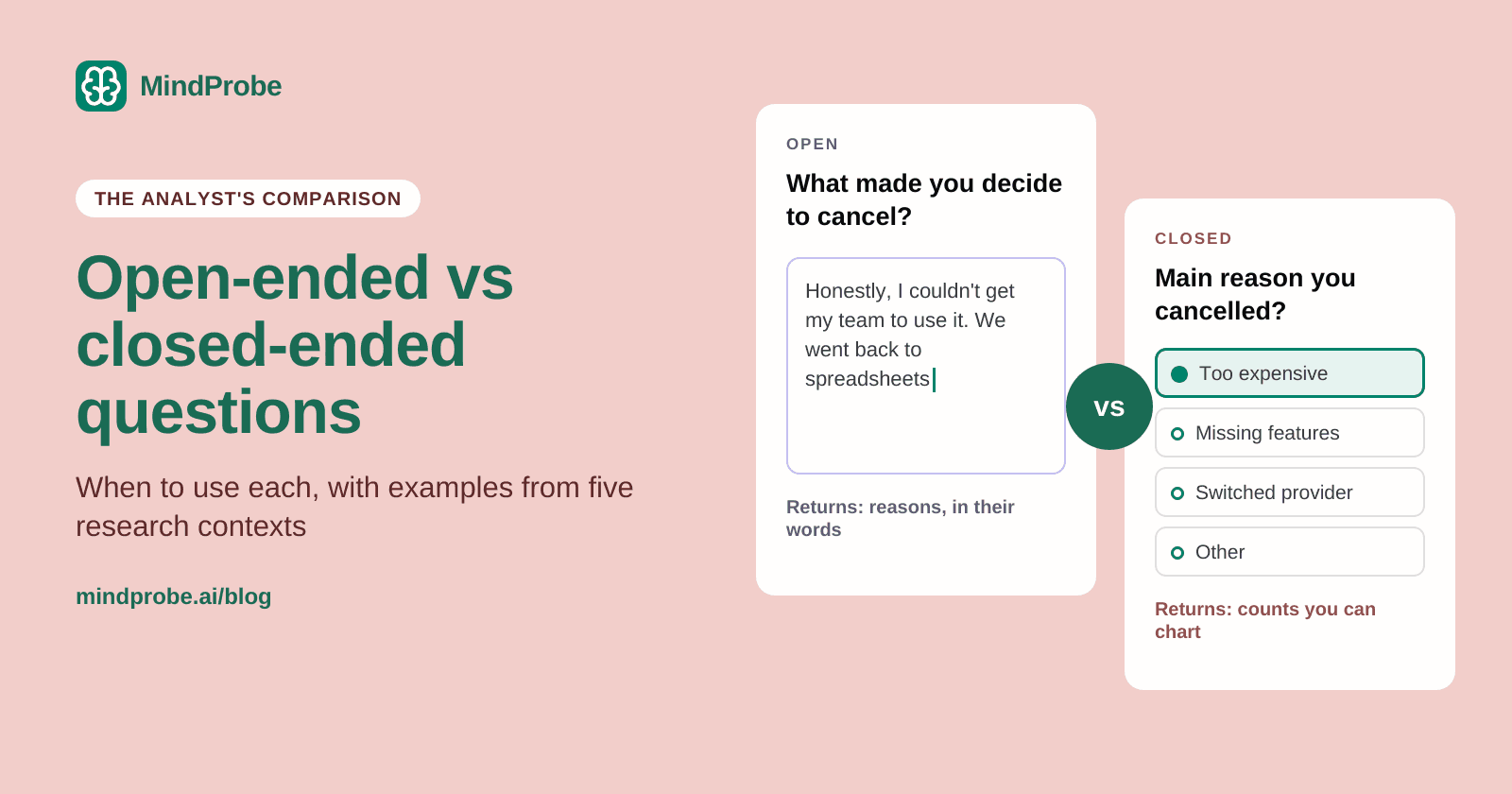
An open-ended question has no answer options. Respondents reply in their own words, so you capture reasons, language and ideas you didn't think to list.
What are open-ended questions?
An open-ended question has no answer options. Respondents reply in their own words, so you capture reasons, language and ideas you didn't think to list.
"What's the one thing you'd change about checkout?" is open. There's no list to anchor on, which is the point. The GESIS survey guideline on open ended questions by Cornelia Züll (2016) lists the classic uses: topics where the answer range is unknown, answers that would need an impossibly long list (occupation is the textbook case), and cases where you want to avoid steering people towards the researcher's own categories.
For a shareable definition, see our glossary entry on the open-ended question.
What are closed-ended questions?
A closed-ended question gives respondents a predefined set of answers to choose from, such as yes/no, multiple choice, rating scales or rankings. Every response maps to a category you can count.
Closed ended questions are the backbone of quantitative surveys because the output is ready to chart. Our glossary has the one-line version of the closed-ended question, and our guide to close-ended questions covers each format and how to write answer options that don't overlap. Likert items are the most common closed format of all, and they get their own treatment in our Likert scale examples.
Key differences: comparison table
Open questions trade scale for depth; closed questions trade depth for scale. Here's how they compare on ten design dimensions.
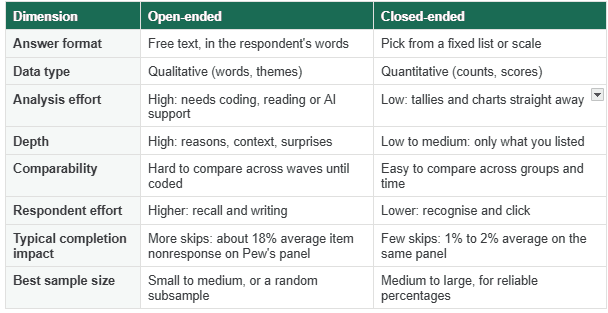

The completion row comes from Pew Research Center's analysis of 92 open-ended questions: open items averaged about 18% nonresponse (range 3% to just over 50%), closed items 1% to 2%. Cognitive burden was the biggest driver, and skips ran higher on mobile.
Bias cuts both ways. Züll notes that dissatisfied people answer open questions more often and at greater length, so angry comments aren't a random sample. Closed questions steer people towards what you show them.
When to use open-ended questions
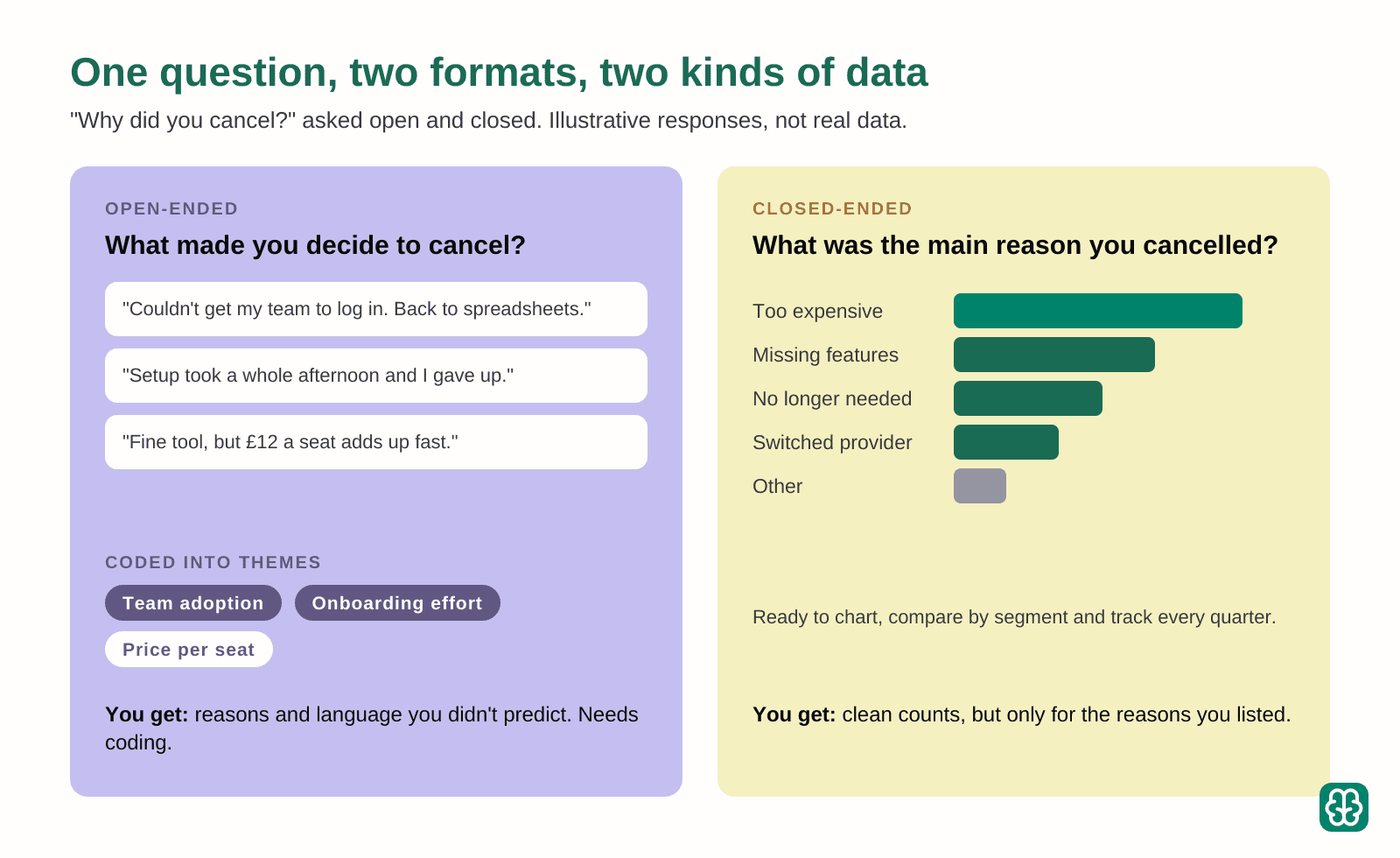
Use open ended questions when you can't confidently list every likely answer, when you need the reason behind a number, or when the customer's own wording is the deliverable.
- Discovery. An open box tells you what the list should contain.
- Explaining a score. An NPS of 31 is a number; "the app keeps logging me out" is a fixable ticket.
- Language mining. Brand teams want customers' exact phrases, not your paraphrase.
- Sensitive counts. Singer and Couper's review cites experiments where open questions drew higher reports of drinking than closed ones.
- Catching mistakes. The same review describes open replies revealing that a closed question's codes had been reversed.
Use open ended questions in small doses. One sharp prompt beats five "any other comments?" boxes, which mostly measure survey fatigue.
HOW MINDPROBE HELPS
Open answers only pay off if someone reads them. MindProbe runs AI sentiment and thematic analysis on every open response as it arrives, so a pile of comments becomes a list of themes, each with its share of mentions and real quotes, in your live dashboard.
When to use closed-ended questions
Use closed ended questions when you already know the realistic answer range and need to measure it: sizing a problem, comparing segments, or tracking change over time.
- Tracking. Brand, engagement and CSAT trackers need identical options every wave.
- Segmentation. You can't cut by "first-time buyers in the North West" unless those are closed fields. Our guide to demographic survey questions covers how to set up those bands.
- Large samples. At 5,000 responses, each open box is 5,000 texts. Closed items scale for free.
- Mobile-first audiences. Tapping beats typing on a phone.
- Thresholds. "Would you pay £9 a month?" needs a yes/no split, not an essay.
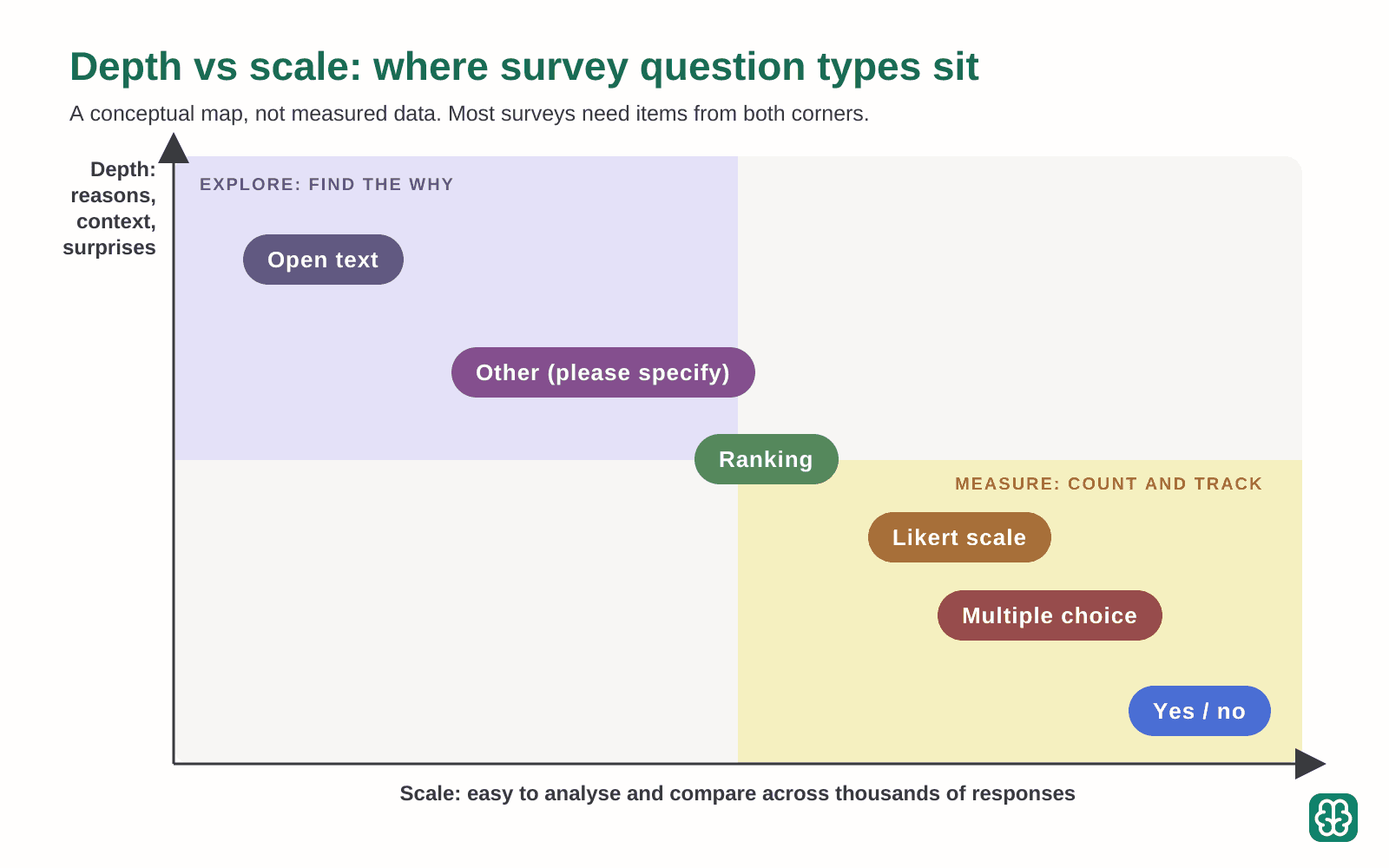
The hard part is the list. Schuman and Presser's classic paper, " The Open and Closed Question" (1979), tested how closely coded open answers matched a pre-written list about what people value in work. The lesson: write closed options from real open answers, not a whiteboard.
HOW MINDPROBE HELPS
Every closed answer in MindProbe lands in a real-time dashboard you can cut by segment and compare across waves. Need a fresh audience rather than your own list? Send the same survey to an on-demand consumer panel.
Open ended question examples across 5 research contexts
Here are open ended question examples paired with closed equivalents in five research contexts, with a pick for each.
1. Customer experience (NPS follow-up)

Choose: open for the first few waves. A fixed list freezes last year's assumptions. Once themes stabilise, promote the top five to a closed list.
2. Product discovery

Choose: open. The workaround nobody listed is the insight.
3. Brand perception

Choose: both, open first so the list can't plant ideas, then closed to track against competitors.
4. Employee feedback

Choose: closed for the trend line, open as an optional follow-up. HR needs comparable scores by department, and free text can identify people in small teams.
5. UX and usability testing

Choose: both. The rating tells you which task is broken; the comment tells you which button.
Can you mix both?
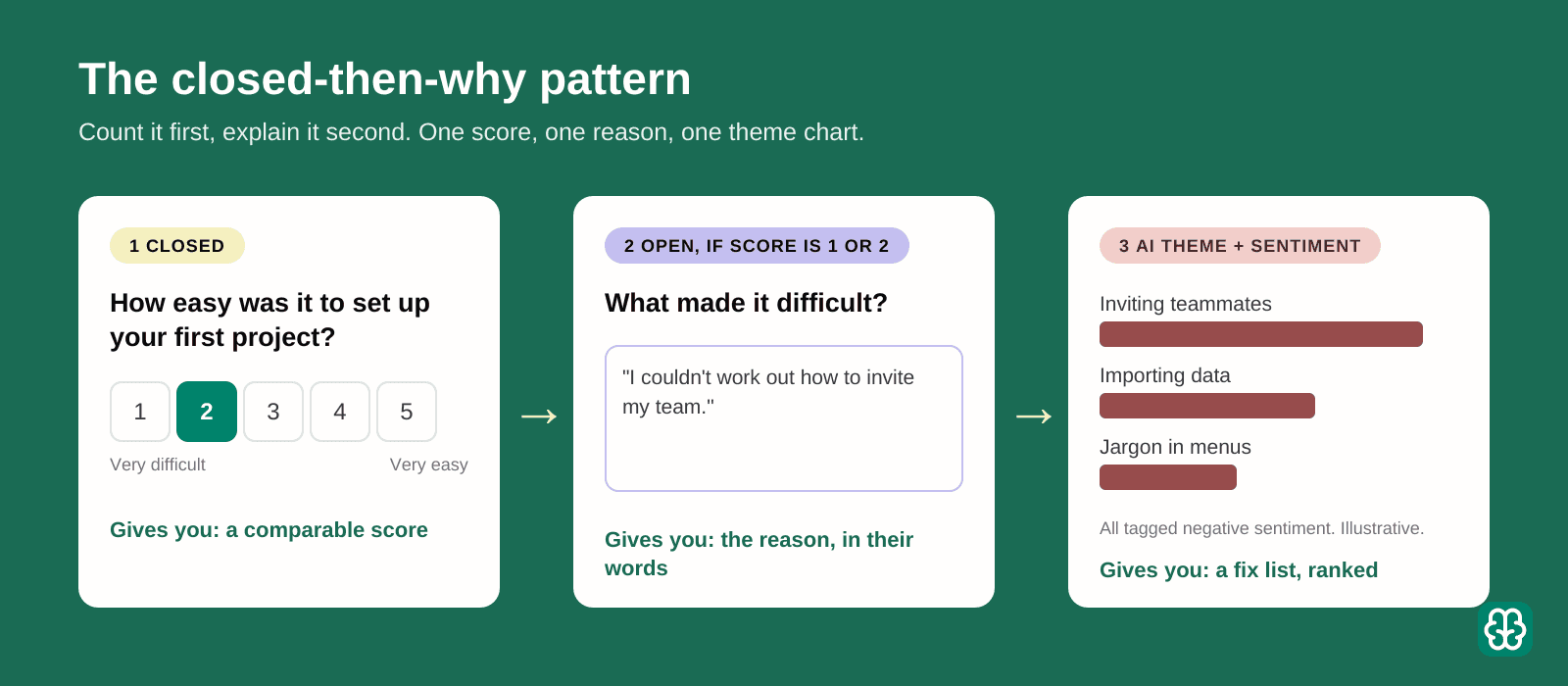
Yes, and most strong questionnaires do. Hybrid formats give you a countable answer plus the reason behind it.
"Other (please specify)"
The cheapest hybrid. If more than a small slice of people pick Other, your list is missing a category, and the text tells you which.
Closed question plus a "why?" follow-up
Ask the rating, then an optional open prompt. A cousin is Schuman's "random probe": Singer and Couper (2017) describe asking open follow-ups of a random subset after closed questions, which clarifies reasons cheaply and still generalises to the full sample.
Open questions in a pilot to build the closed list
Ask it open with 30 to 50 people, code the answers, and turn the top themes into closed options. Our guide on how to write good survey questions covers how to pilot test the rest of the questionnaire.
Analysing open text at scale with AI
The old objection to open ended questions was coding cost. AI theme and sentiment coding changes the maths: thousands of comments grouped and tagged in minutes, then checked by a human. In MindProbe, open-text responses get AI sentiment analysis and sit beside closed results in real-time dashboards.
Rule of thumb: how many open questions?
How to analyse open-ended answers
- Read a sample first. Skim 50 to 100 responses before building anything.
- Build a codebook. Züll recommends a label, definition and anchor examples per category, with a second coder checking about 10% of responses.
- Code manually or with AI. Manual suits a few hundred answers. Above that, use AI coding and validate it against a hand-coded sample.
- Quantify the themes. Report the share mentioning each theme, with the base size.
- Quote verbatims. Two or three per theme. One good quote often moves a room more than a chart.
Writing tips (for both types)
Make open ended questions narrow and specific, and closed options complete and non-overlapping. Either way, ask one thing at a time.
For open-ended questions
- Focus the prompt. "What nearly stopped you buying?" beats "Any thoughts?" Open questions lack the cues a list gives, so they need sharper focus.
- Split positives and negatives into two questions, as Züll advises.
- Size the box to the answer. Smyth, Dillman, Christian and McBride (2009) found larger answer boxes substantially improved response quality among late responders, and that a short line stressing why detail matters improved answers from everyone.
- Say why it matters. "Your answer goes straight to the product team" costs eight words.
For closed-ended questions
- Write options from evidence: pilot data or past open answers.
- Make them complete and exclusive. Every respondent should have exactly one right box, or a clearly labelled multi-select.
- Balance your scales to limit response bias.
- Read your "Other" answers. They're free list improvements.
MindProbe's 30+ question types cover both sides, with logic and branching to show a "why?" only when needed. For the full catalogue of formats, see Survey Question Types: The Complete Guide, and if you're starting from a blank page, our explainer on what a questionnaire is sets out the building blocks.
EXPERT PERSPECTIVE
Eleanor Singer and Mick Couper argue open ended questions are underused. In their experience, adding a few to computerised surveys is neither expensive nor time-consuming, and respondents are willing and able to answer.
Paraphrased from Singer and Couper (2017), methods, data, analyses
Frequently Asked Questions
What is the difference between open-ended and closed-ended questions?
Open ended questions let respondents answer in their own words; closed ended questions offer fixed answers. Open questions reveal reasons, closed questions produce comparable numbers.
What are some open ended question examples?
"What's the main reason for your score?", "What three words come to mind when you think of our brand?" and "What, if anything, was confusing about this page?" are all open ended question examples.
Are open ended questions qualitative or quantitative?
The raw answers are qualitative text. Once you code them into themes, you can count how often each theme appears, which turns them into quantitative data you can chart.
How many open ended questions should a survey have?
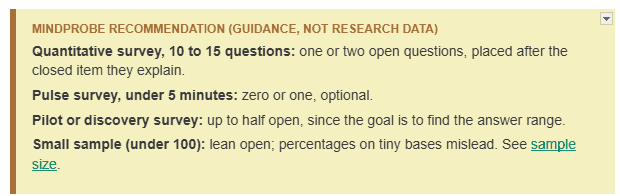
MindProbe recommends one or two in a typical 10 to 15 question quantitative survey, and more in pilots or discovery work.
Which survey question types are closed-ended?
Yes/no, multiple choice, rating, Likert, ranking and matrix questions are all closed-ended survey question types.
Ask it both ways, analyse it in one place
Mix 30+ question types, add an open "why?" and see AI sentiment on every comment in a live dashboard. Start from a template or a blank page.
References
- Asare-Marfo, D. (2021). Why do some open-ended survey questions result in higher item nonresponse rates than others? Pew Research Center, Decoded, 14 October 2021.
- Schuman, H. and Presser, S. (1979). The open and closed question. American Sociological Review, 44(5), 692 to 712.
- Singer, E. and Couper, M. P. (2017). Some methodological uses of responses to open questions and other verbatim comments in quantitative surveys. methods, data, analyses, 11(2), 115 to 134.
- Smyth, J. D., Dillman, D. A., Christian, L. M. and McBride, M. (2009). Open-ended questions in web surveys: Can increasing the size of answer boxes and providing extra verbal instructions improve response quality? Public Opinion Quarterly, 73(2), 325 to 337.
- Züll, C. (2016). Open-Ended Questions. GESIS Survey Guidelines. Mannheim: GESIS Leibniz Institute for the Social Sciences.