Demographic Survey Questions: What to Ask and What to Avoid

Samee
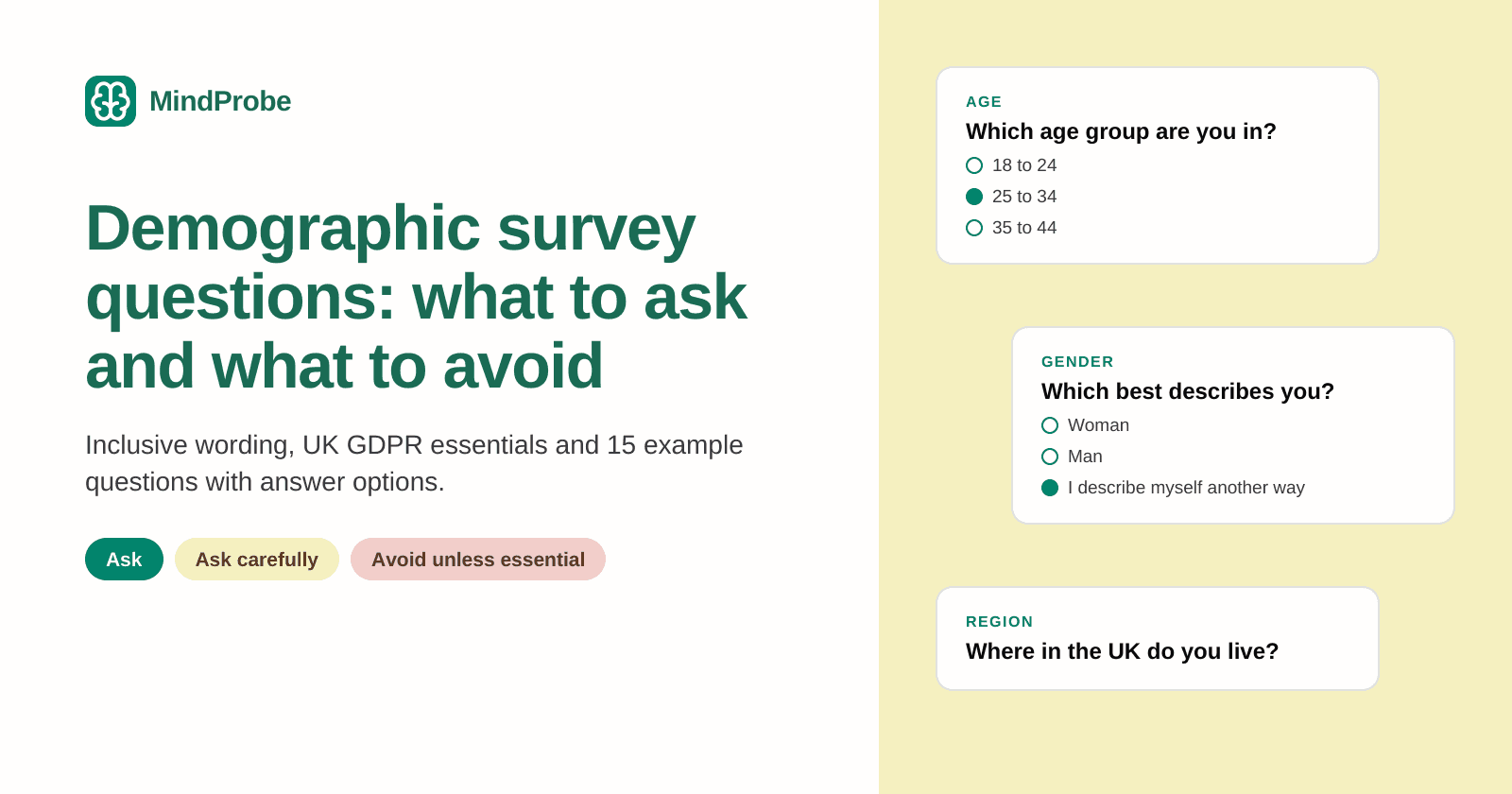
Every researcher drafting a demographic survey hits the same moment: "Do I really need to ask this?" Picture a skincare brand surveying repeat customers who churn after their third order. By review stage, the draft has picked up ethnicity, religion, sexual orientation and exact salary, each added "just in case." None maps to a decision. Three are special category data under UK GDPR. Each is another reason to close the tab. This guide shows which demographic questions to ask, how to word them inclusively, what the law expects, and 15 examples with answer options.
Key Takeaways
- Only ask a demographic question if the answer will change an analysis or a decision.
- Ethnicity, health, sexual orientation and religion are special category data: you need an Article 6 lawful basis and an Article 9 condition.
- Use mutually exclusive age and income bands, and offer "Prefer not to say."
- Put demographic questions at the end, unless they are screeners.
- For UK work, start from the GSS harmonised standards.
What is a demographic survey?
A demographic survey collects facts about who your respondents are (age, gender, location, income, household) so you can describe your sample and compare groups.
Most demographic questions sit inside a wider study. They let you cut results by group, the basis of audience segmentation, and check your sample matches your population. See our glossary entry on the demographic survey, or our guide to survey question types for how these items fit with other formats
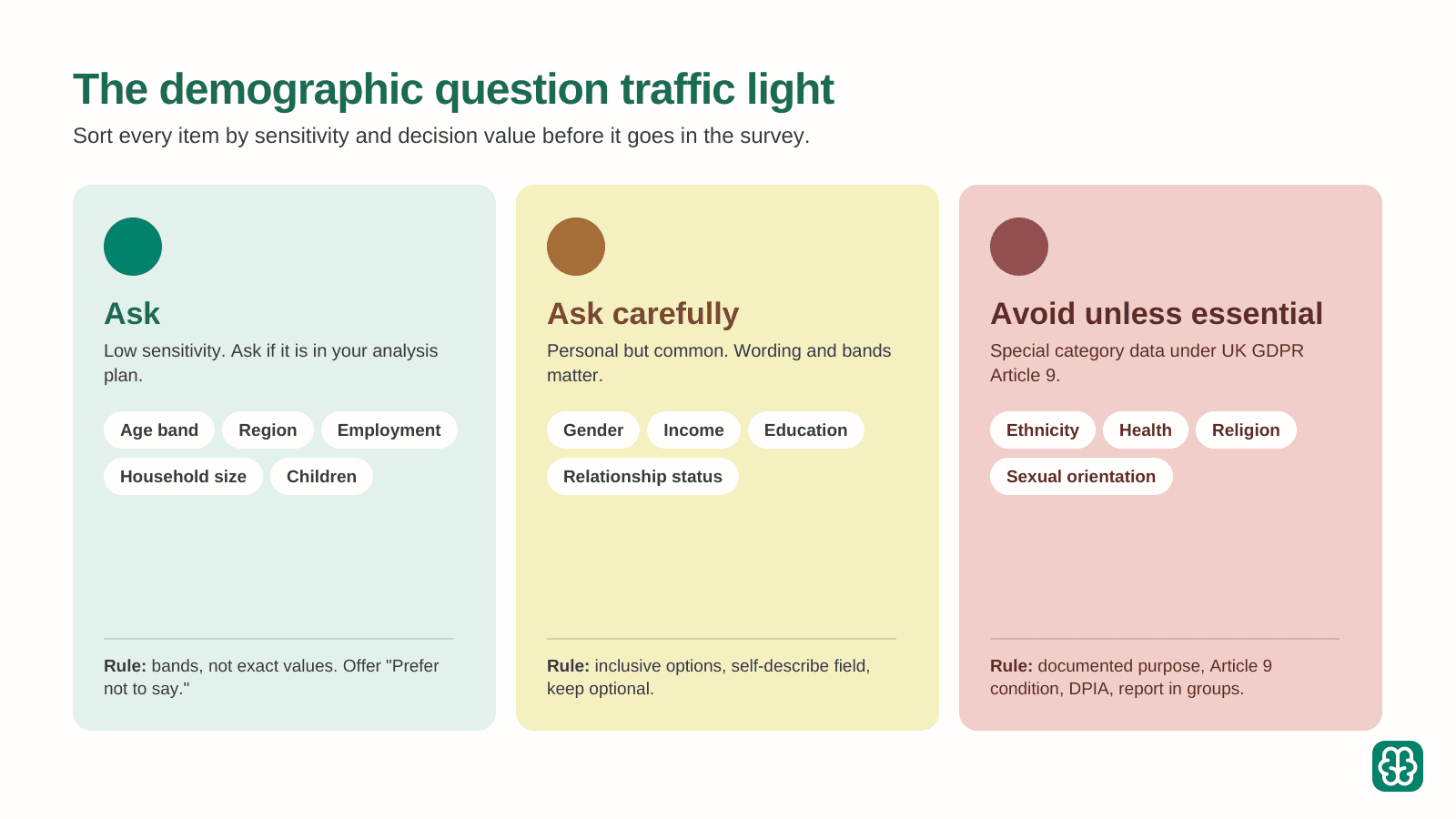
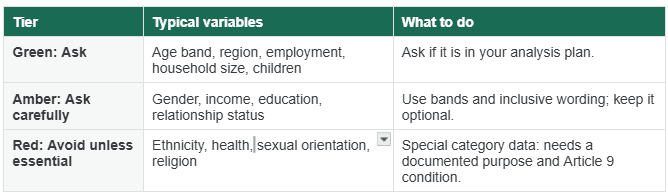
The Ask / Ask carefully / Avoid unless essential framework
Sort every demographic item into one of three tiers by sensitivity and decision value, then treat each tier differently.
The data minimisation test: 4 questions before you add any item
Before a demographic question goes into the draft, it should pass four checks. If it fails any one of them, leave it out.
The ICO is blunt on this point: you must not collect personal data on the off-chance it might be useful in the future. Here is how that principle translates into survey design.
- Which analysis will use it? Name the cut. "Churn reasons by age band" passes; "might be interesting" does not.
- Will the answer change a decision? If every segment gets the same campaign, the variable adds risk, not value.
- Is there a less sensitive alternative? Age band, not date of birth. Region, not postcode.
- Will each group be big enough? Check your sample size per segment first.
What does UK GDPR expect from demographic questions?
Under UK and EU GDPR, demographic answers linked to a person are personal data, and some categories carry extra rules.
Lawful basis and Article 9 special category data
Every survey collecting personal data needs an Article 6 lawful basis. Ethnicity, religion, health, sex life and sexual orientation (plus politics, union membership, genetic and biometric data) are special category data. For these the ICO says you need both an Article 6 lawful basis and a separate Article 9 condition, decided before you start; a DPIA becomes more likely. EU GDPR uses the same list. The ICO is reviewing this guidance after the Data (Use and Access) Act 2025, so check for updates.
Anonymous or pseudonymous?
Truly anonymous responses fall outside GDPR, but most surveys aren't anonymous. If a respondent ID links to your CRM, the data is pseudonymised and still personal. Tiny segments re-identify people too.
Consent wording and retention
If you rely on explicit consent for special category items, ask separately, in plain words, and state your retention period.
EXAMPLE CONSENT WORDING
"The next three questions ask about ethnicity, health and religion. They are optional. We report answers only in groups of 30 or more and delete raw responses after 12 months. Tick the box if you are happy to answer."
GDPR CHECKLIST FOR DEMOGRAPHIC QUESTIONS
Every item passes the data minimisation test
Article 6 basis recorded, plus an Article 9 condition for special category items
DPIA completed or screened
Privacy notice with purpose and retention period
"Prefer not to say" on sensitive items; no forced answers
Results reported only for groups large enough to prevent re-identification
Deletion date in the calendar
How do you write inclusive demographic questions?
Inclusive demographic questions let every respondent see themselves in the options, self-describe, or decline.
- Offer "Prefer not to say." In Census 2021, 7.5% of people aged 16 and over skipped the voluntary sexual orientation question. Respect non-response.
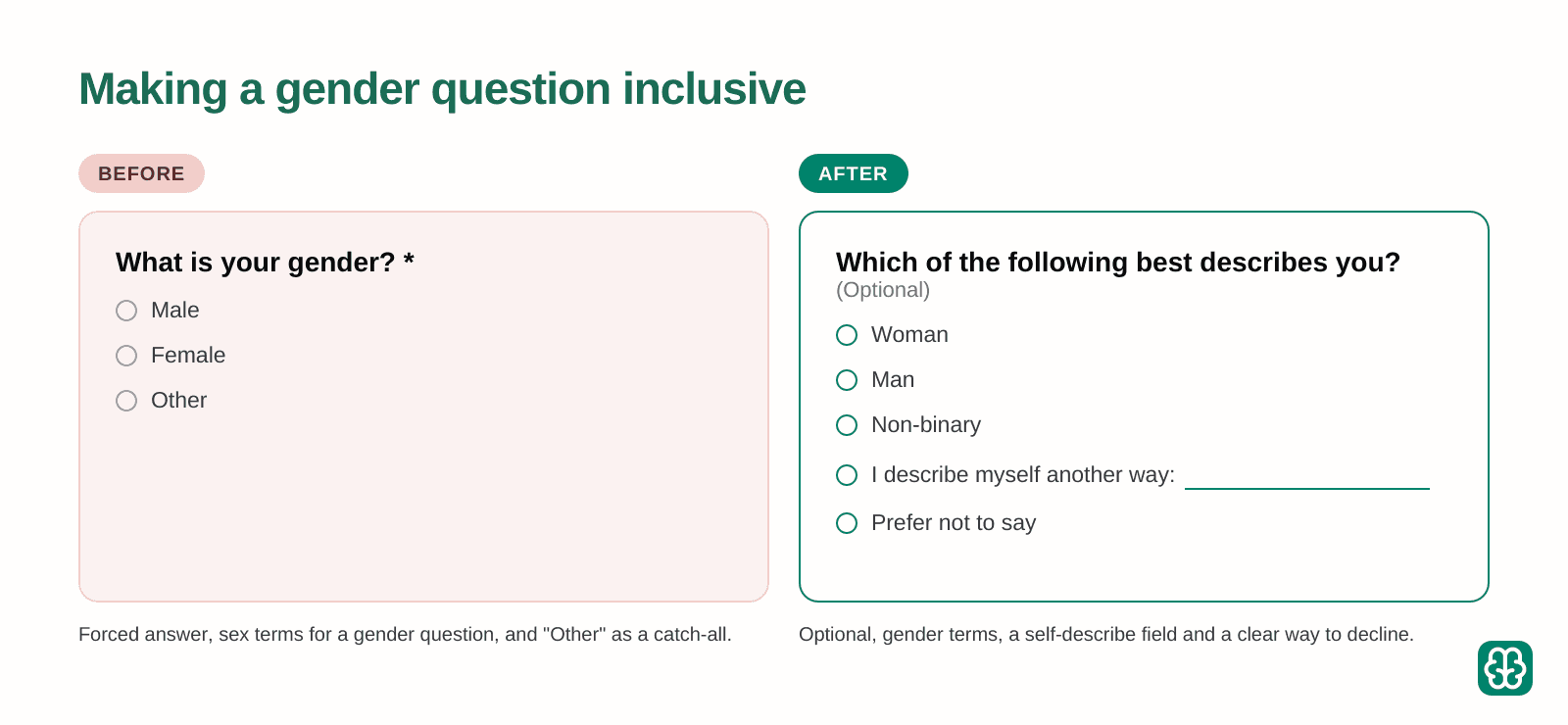
- Use self-describe fields, not "Other.""I describe myself another way" reads as an invitation; "Other" reads as an afterthought.
- Allow multiple answers where identity overlaps.
- Say why you ask. One line of purpose builds trust.
- Use harmonised standards. The GSS ethnicity harmonised standard asks "What is your ethnic group?" across five high-level groups.
For general wording rules such as leading language, see how to write good survey questions.
Sex and gender identity: which question do you need?
These are different variables. The GSS sex harmonised standard, published October 2026, offers two versions (sex at birth, or sex as on a birth or Gender Recognition Certificate) and says never to use both. Gender identity has interim GSS guidance only: ask it after sex, keep it voluntary. Most marketing research needs gender, not sex, so ask one inclusive gender question.
EXPERT PERSPECTIVE
Pew Research Center replaced "Are you male or female?" with "Do you describe yourself as a man, a woman, or in some other way?" plus a text box. Its 2020 test found no measurable rise in refusals.
Source: Pew Research Center, 2020
How should you design age bands and income bands?
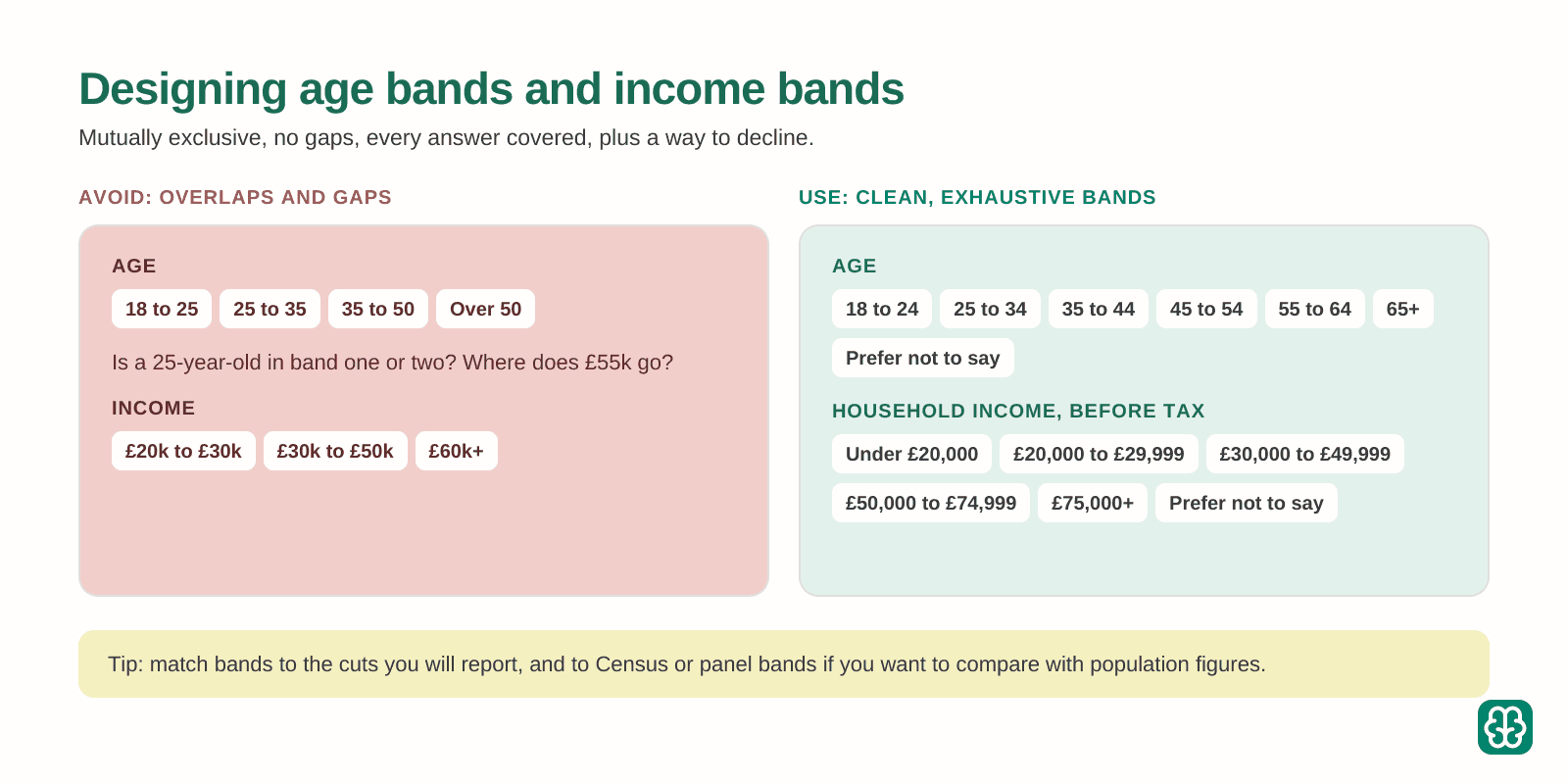
Use bands that are mutually exclusive, cover every possible answer, and match the cuts you plan to report.
Overlapping bands such as "18 to 25" and "25 to 34" leave a 25-year-old stuck. Bands also lower sensitivity: people share "£30,000 to £49,999" more readily than a salary. Say whether income is household or personal, before or after tax.
HOW MINDPROBE HELPS
Panel targeting can save you questions. When you field a survey to MindProbe's on-demand consumer panel, you can target by demographics such as age, region or income up front, instead of screening people out with extra items at the start.
Where should demographic questions go in a survey?
Put demographic questions at the end, unless they are screeners that decide who qualifies for the survey.
Opening with personal questions feels like a form, and early sensitive items raise drop-off. The exception is screening: if you only want 25 to 44 year-olds in London, ask age and region first and route others out with skip logic. With MindProbe's consumer panels you can target by demographics up front, so you may not need screeners at all.
15 demographic survey questions with recommended answer options
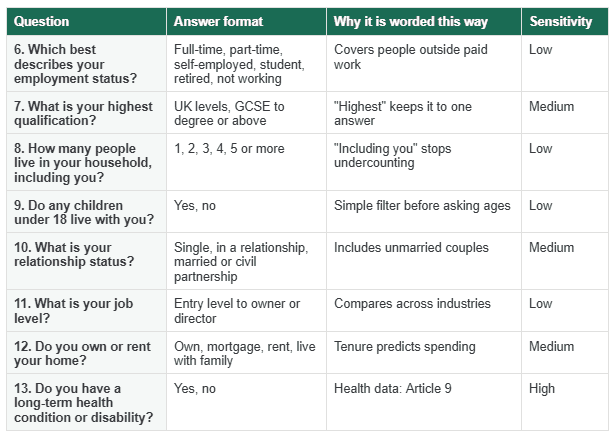
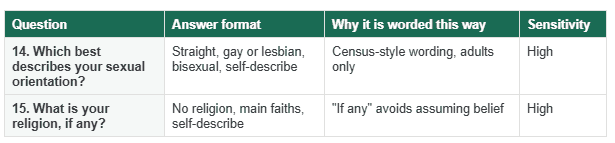
Here are 15 demographic questions to adapt: five as full cards, ten in the table.
1. AGE (GREEN)
Which age group are you in?
- Under 18
- 18 to 24
- 25 to 34
- 35 to 44
- 45 to 54
- 55 to 64
- 65 or over
- Prefer not to say
Bands, not date of birth. "Under 18" screens out minors.
2. GENDER (AMBER)
Which of the following best describes you?
- Woman
- Man
- Non-binary
- I describe myself another way: ______
- Prefer not to say
A self-describe option replaces "Other."
3. REGION (GREEN)
Where in the UK do you live?
- England: London
- England: North
- England: Midlands
- England: South
- Wales
- Scotland
- Northern Ireland
- Outside the UK
Group regions to the level you will report. Skip postcode unless you will map results.
4. HOUSEHOLD INCOME (AMBER)
What is your total household income per year, before tax?
- Under £20,000
- £20,000 to £29,999
- £30,000 to £49,999
- £50,000 to £74,999
- £75,000 to £99,999
- £100,000 or more
- Don't know
- Prefer not to say
Defines household and tax status, no overlaps.
5. ETHNICITY (RED: SPECIAL CATEGORY)
What is your ethnic group? (Optional)
- White
- Mixed or multiple ethnic groups
- Asian or Asian British
- Black, Black British, Caribbean or African
- Other ethnic group: ______
- Prefer not to say
GSS high-level groups. Include only with a documented purpose and Article 9 condition.
HOW MINDPROBE HELPS
MindProbe includes dedicated personal-information question types alongside single choice and dropdowns, so clean bands and a "Prefer not to say" option take seconds to set up and can be reused across every survey.
From demographic questions to segments
Demographic questions pay off when you cut the rest of the survey by them.
In MindProbe, each demographic item becomes a filter in the live AI dashboard, so you can compare churn reasons for 25 to 34s against 55 to 64s in real time. Banded close-ended questions keep cuts clean.
Frequently Asked Questions
What are the most common demographic survey questions?
Age, gender, region, household income, education, employment and household size.
Is a demographic survey covered by GDPR?
Yes, if answers can be linked to a person, directly or through an ID. Only truly anonymous data falls outside it.
Should demographic questions be mandatory?
Rarely. Forced answers raise drop-off and invite false responses. Keep sensitive items optional.
How should I ask about gender in a survey?
Offer woman, man, non-binary, a self-describe field and "Prefer not to say."
Where do demographic questions go in survey design?
At the end, except screener questions, which go first.
Cut your results by any segment, instantly
Build a demographic survey, target a consumer panel by age, region or income, and filter every answer by segment in a live AI dashboard.