Close-Ended Questions: Definition, Examples and When to Use Them

Samee
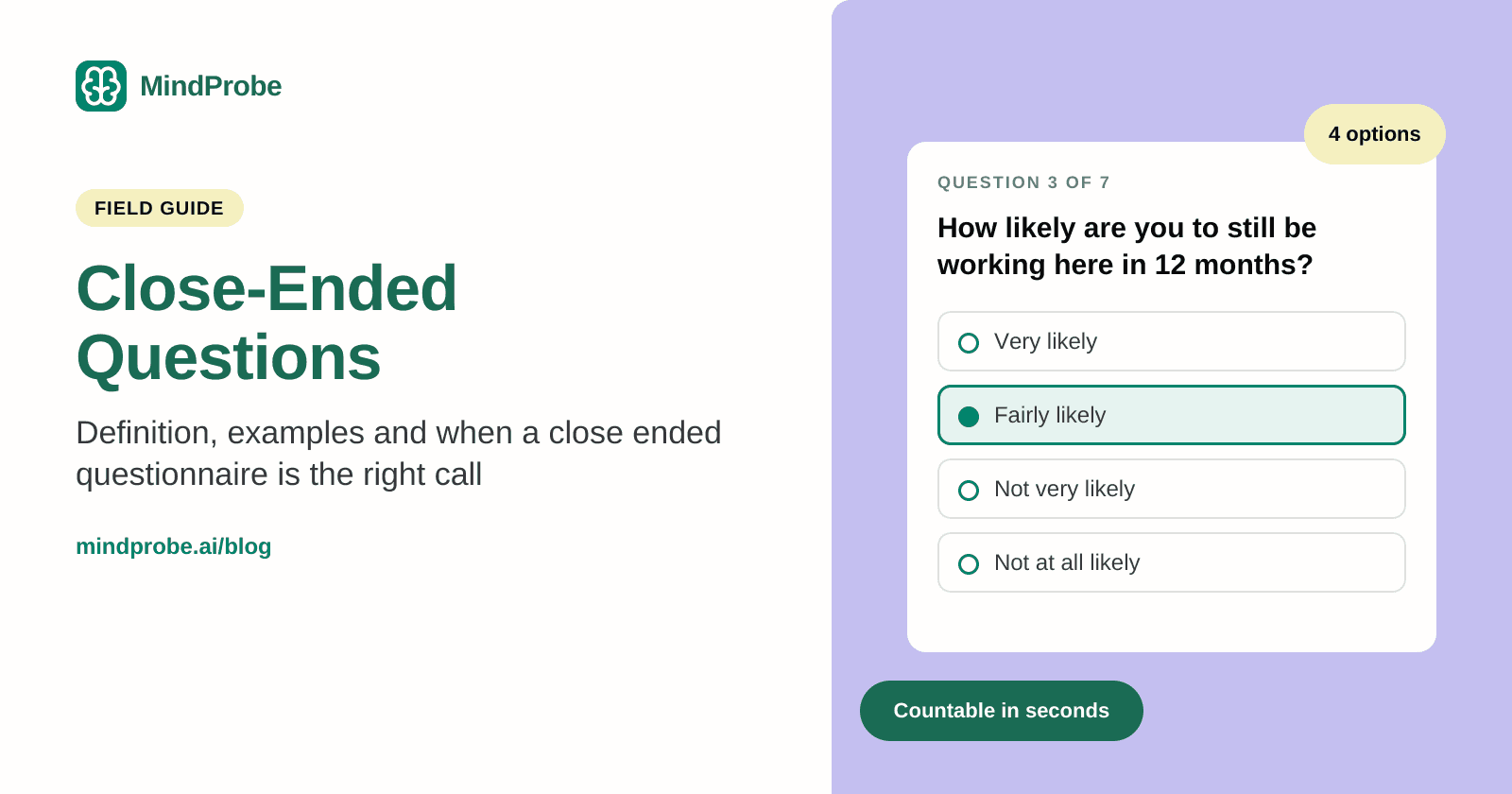
Picture an HR lead on a Friday afternoon with 400 free-text exit survey comments and a Monday deadline to name the top reason people are leaving. Now picture the same survey built as a close ended questionnaire: one question listing eight reasons, one box for anything else. The answer is a bar chart, ready before the kettle boils. That's the trade. You give up some richness and get speed and numbers you can track quarter after quarter. This guide covers the main types with examples, pros and cons, answer options that don't leak, and a checklist for when closed is the right call.
Key Takeaways
- A close ended questionnaire gives respondents fixed answers to choose from, so results can be counted and compared straight away.
- The main types are single-choice, multi-select, yes/no, rating, Likert, ranking, semantic differential and matrix questions.
- Closed questions steer answers: in a Pew Research Center experiment, 58% picked the economy when it was offered, but only 35% named it unprompted.
- Answer options must be exhaustive and mutually exclusive. Use "Other (please specify)" and "Prefer not to say" deliberately, not by habit.
- Most good surveys are mostly closed, plus one open box.
What is a close ended questionnaire?
A close ended questionnaire is a survey made up of questions with predefined answer options, so respondents choose rather than write. Each answer maps to a category or number you can tally, chart and compare.
Each item is a closed-ended question, such as "Did you attend onboarding?" with Yes and No. The opposite is an open-ended question; we compare the two in Open-Ended vs Closed-Ended Questions.
You'll also hear "closed questionnaire" or "structured questionnaire". Same idea.
Types of closed ended questions: a quick-reference guide
There are six core types of closed-ended questions (single-choice, multi-select, yes/no, rating, Likert and ranking), plus two common variants: semantic differential and matrix grids.
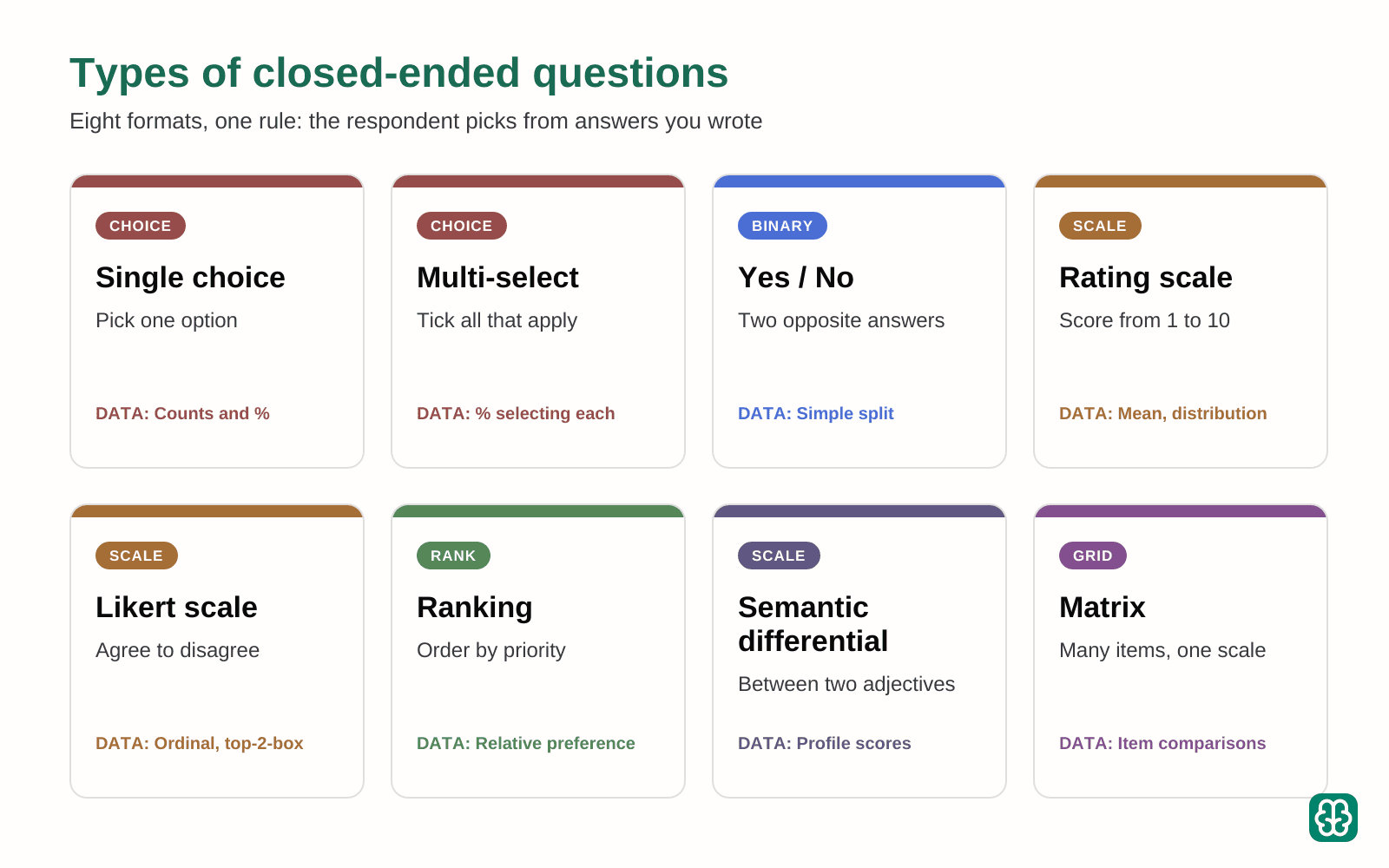
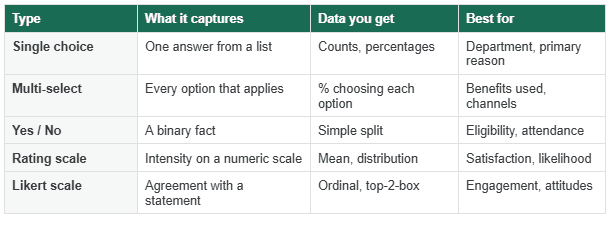
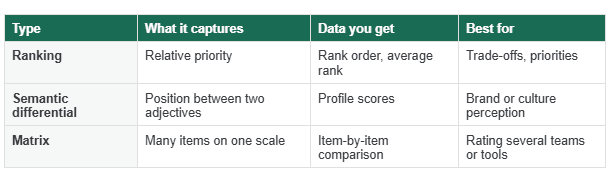
For every format, open and closed, see Survey Question Types: The Complete Guide. Here's each closed type in practice.
Multiple choice (single answer)
The workhorse. One question, a list, one pick. Use it when answers genuinely can't overlap.
SINGLE CHOICE
Which team do you work in?
- Sales
- Operations
- Product and engineering
- Finance
- People and HR
- Other (please specify)
Multiple choice (multi-select)
Tick everything that applies. Results won't sum to 100%, so say so on the chart.
MULTI-SELECT
Which of these benefits have you used in the past 12 months? (Select all that apply)
- Private medical cover
- Cycle to work scheme
- Employee assistance programme
- Learning budget
- None of these
Yes/no (dichotomous)
Best for facts, not feelings. "Do you like your job?" squeezes a complicated answer into two boxes.
DICHOTOMOUS
Did you receive a written job description before your start date?
- Yes
- No
Rating scale
A numbered scale with labelled ends, good for intensity and trends. See our rating scale entry.
RATING SCALE
How likely are you to recommend this company as a place to work?
- 0 (Not at all likely) to 10 (Extremely likely)
Displayed as an 11-point horizontal scale.
Likert scale
A statement plus an agreement scale, the backbone of engagement surveys. The Likert scale guide covers 5 versus 7 points; the Likert scale definition is in our glossary.
LIKERT
"I have the tools I need to do my job well."
- Strongly disagree
- Disagree
- Neither agree nor disagree
- Agree
- Strongly agree
Ranking
Forces trade-offs. Cap it at five items.
RANKING
Rank these from most to least important to you (1 = most important):
- Pay
- Flexible working
- Career progression
- Manager quality
- Job security
Semantic differential and matrix (briefly)
A semantic differential sits a scale between two opposites, such as Rigid and Flexible. A matrix stacks items against one scale; keep it short to avoid straight-lining.
MATRIX
How satisfied are you with each of the following?
- Your workload
- Recognition for your work
- Communication from leadership
Columns: Very dissatisfied, Dissatisfied, Neutral, Satisfied, Very satisfied.
HOW MINDPROBE HELPS
All eight formats are among MindProbe's 30+ question types, and logic and branching mean a "No" can skip the follow-ups that no longer apply. Shorter paths, cleaner data.
Pros and cons of closed ended questions
Closed questions are fast to answer and analyse, but the options you provide shape the answers you get.
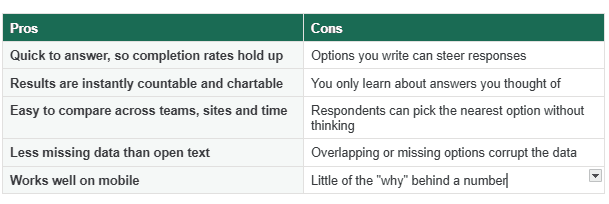
The steering effect is real. In an experiment reported by the Pew Research Center, voters were asked which issue mattered most in the 2008 presidential election. When the economy was offered as an option, 58% chose it; only 35% named it when asked open-ended. Fewer than 1 in 10 of the closed group gave an answer outside the five listed, while 43% of the open group did.
The upside: a web survey experiment by Reja and colleagues (2003) found open-ended questions produced more missing data and more inadequate answers than closed ones.
EXPERT PERSPECTIVE
Jon Krosnick and Stanley Presser note that an "Other" option does little to rescue a missing category, because respondents stick to the choices offered. They also describe satisficing: when effort or motivation dips, people pick a good-enough answer instead of the most accurate one.
Paraphrased from Krosnick and Presser, Question and Questionnaire Design (2010)
How do you write answer options that cover every answer?
Make every option list exhaustive (every realistic answer has a home) and mutually exclusive (no answer fits two boxes). Pew calls out both rules in its guidance on closed-ended questions.
Call it the MECE problem: mutually exclusive, collectively exhaustive. Overlapping ranges are the classic slip.
BEFORE: OVERLAPS AND GAPS How long have you worked here?
- 0 to 1 year
- 1 to 3 years
- 3 to 5 years
- 5 years or more
- Someone with exactly 1 or 3 years fits two boxes.
AFTER: EXHAUSTIVE AND MUTUALLY EXCLUSIVE How long have you worked here?
- Less than 1 year
- 1 year to less than 3 years
- 3 years to less than 5 years
- 5 years or more
- Prefer not to say
- Use "Other (please specify)" for open-ended lists like tools, reasons or channels. Better still, pilot it open-ended with 20 people and build options from their answers, as Pew suggests.
- Use "Prefer not to say" on sensitive items such as age, ethnicity, health or salary, so nobody is forced to guess or quit.
- Borrow standard lists where they exist. For ethnicity in the UK, the GOV.UK harmonised standard includes "Any other background, please describe" options.
- Add "None of these" to multi-select so you can tell a real zero from a skipped question.
- Keep scales in fixed order, but randomise long unordered lists: self-completers favour options near the top.
For wording the question stem itself, see how to write good survey questions.
HOW MINDPROBE HELPS
Not sure your list covers every answer? Run a short open-ended pilot, let MindProbe's thematic analysis group the replies, and turn the biggest themes into your closed options. Your "Other" box will thank you.
When to use a close ended questionnaire: a 5-question decision checklist
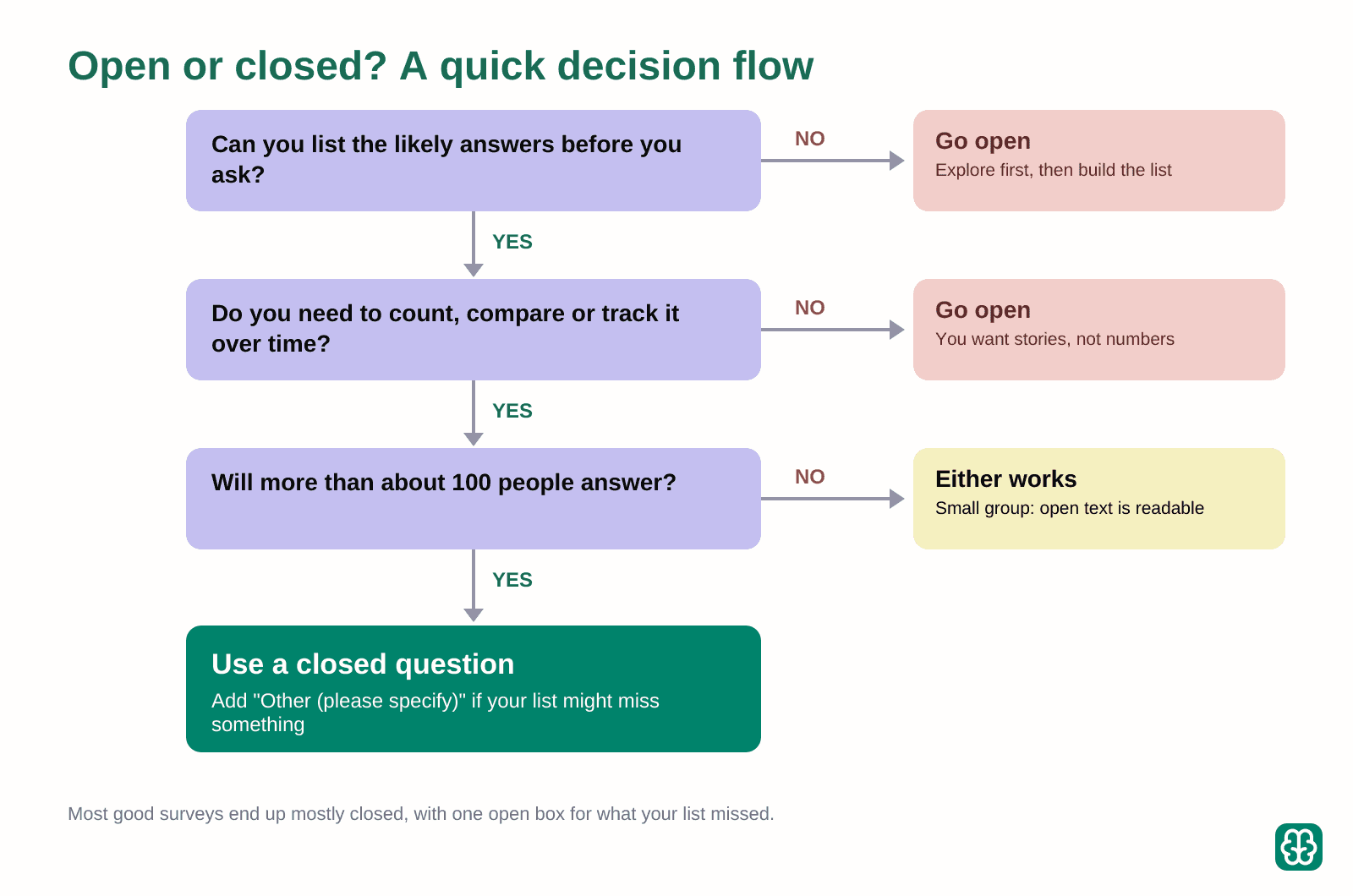
Use a close ended questionnaire when you know the likely answers, need comparable numbers, and expect more responses than you can read.
- Can you list the likely answers? If not, run an open pilot first.
- Do you need to compare groups or track change? Closed answers make 12 sites or 4 quarters comparable.
- Is the sample large? Above about 100 responses, reading every comment stops being realistic.
- Is the topic factual or attitudinal, rather than exploratory? Closed questions measure; they don't discover.
- Will respondents answer on a phone? Taps beat typing on small screens.
Four or five yeses: a close ended questionnaire will serve you well. Two or fewer: start open, then turn what you learn into a closed questionnaire next round.
When not to use closed questions
Skip them for discovery work, tiny samples and questions where the honest answer is "it depends". Five boxes for a complicated experience gives you a tidy, misleading chart.
Worked example: a 7-question employee pulse survey
A monthly pulse: six closed questions for trends, one open box for the rest.
- Which team do you work in? (single choice)
- "I'd recommend this company as a great place to work." (Likert, 5 points)
- How manageable has your workload been this month? (rating, 1 to 5)
- Have you had a one-to-one with your manager in the past four weeks? (yes/no)
- Which of these would most improve your week? (multi-select, with None of these)
- Rank these priorities for next quarter: pay review, hybrid policy, training, tooling. (ranking)
- Is there anything else you'd like leadership to know? (open text, optional)
In MindProbe you can start from a pre-built employee engagement survey in the template library, adjust the options, and send it by email or web link. Results land in a live dashboard, and AI sentiment analysis summarises the open box, so you get numbers and reasons without reading 400 comments.MindProbe recommends keeping a monthly pulse under three minutes.
Frequently asked questions about close-ended questions
What is a close ended questionnaire?
A close ended questionnaire is a survey where every question gives respondents a fixed set of answers to choose from, such as yes/no, multiple choice, rating scales or rankings. Answers are easy to count and compare.
What is the difference between closed and open-ended questions?
Closed-ended questions offer preset answers; open-ended questions let people reply in their own words. Closed gives you comparable numbers, open gives you reasons.
Is a Likert scale a closed-ended question?
Yes. A Likert item asks people to pick one point on a fixed agreement scale, so it is closed-ended and produces ordinal data.
How many answer options should a closed question have?
Enough to cover every realistic answer without overlap, and few enough to scan at a glance. For most single-choice lists that means roughly 4 to 8 options.
Build your next closed questionnaire in minutes
Start from a template, add your answer options, and watch results land in a live dashboard with AI analysis built in.
References
- Rubenstein, S. (2021). Writing Survey Questions. Pew Research Center.
- Reja, U., Lozar Manfreda, K., Hlebec, V. and Vehovar, V. (2003). Open-ended vs. close-ended questions in Web questionnaires. Metodološki zvezki, 19, 159 to 177.
- Krosnick, J. A. and Presser, S. (2010). Question and Questionnaire Design. In P. V. Marsden and J. D. Wright (eds), Handbook of Survey Research, 2nd edn. Emerald.
- Krosnick, J. A. (1991). Response strategies for coping with the cognitive demands of attitude measures in surveys. Applied Cognitive Psychology, 5, 213 to 236.
- Government Analysis Function. Ethnicity harmonised standard. GOV.UK.